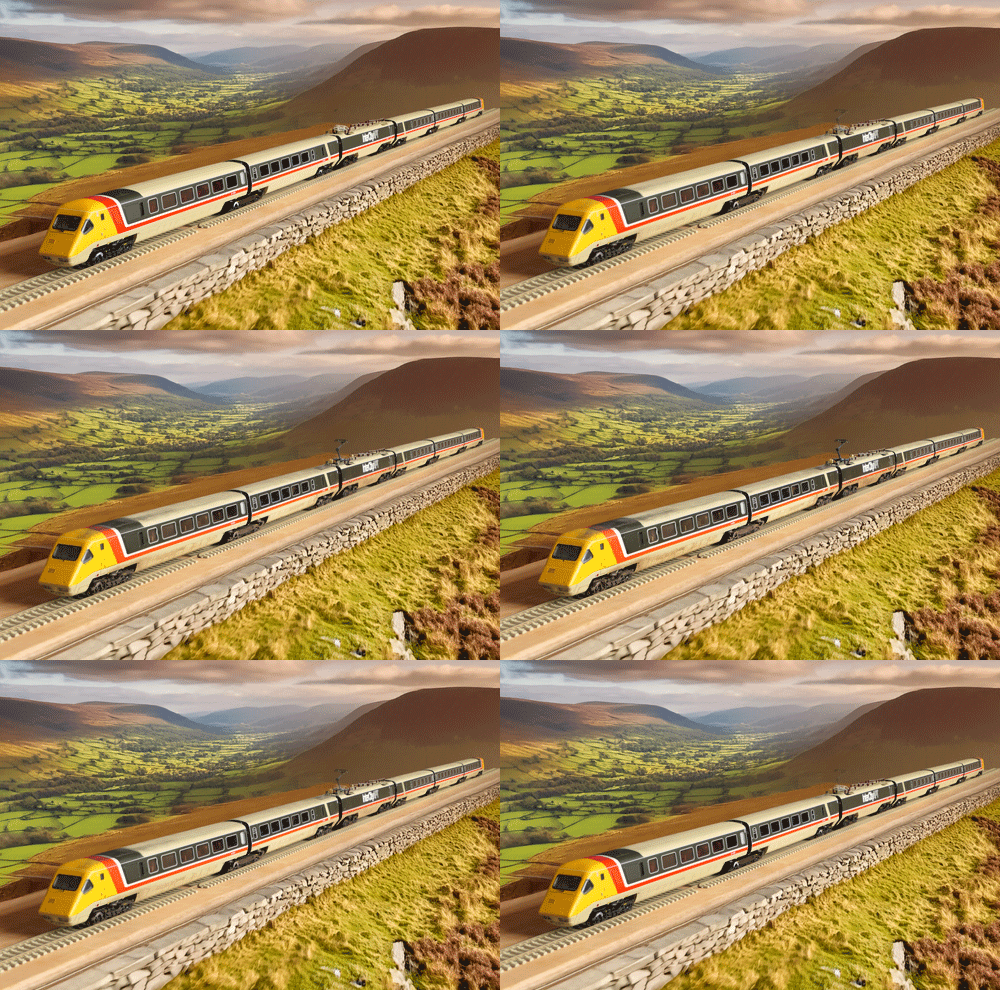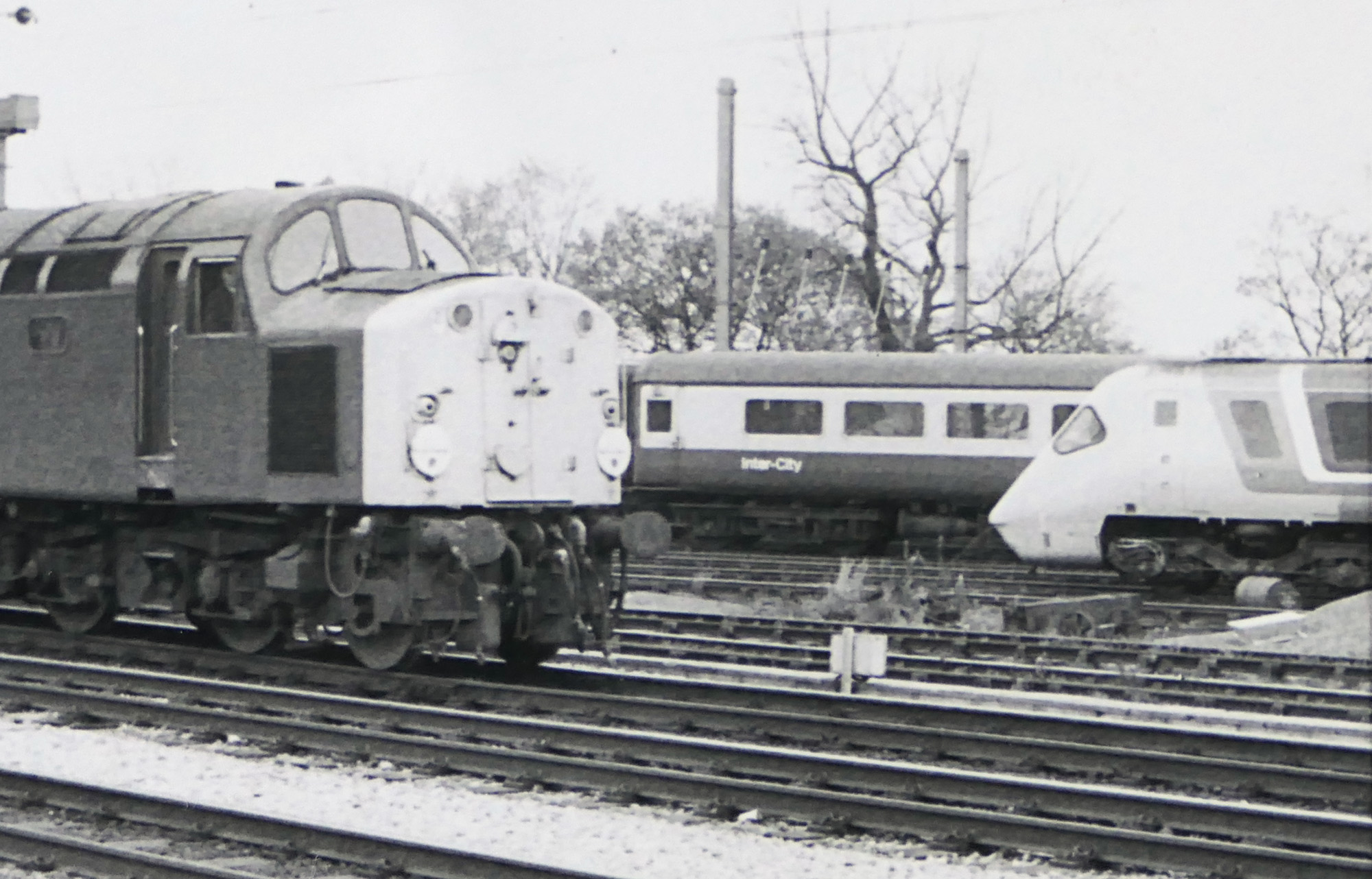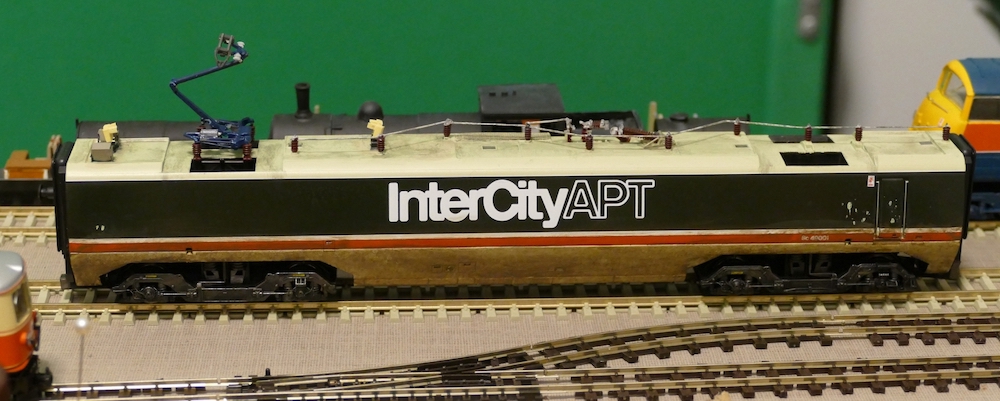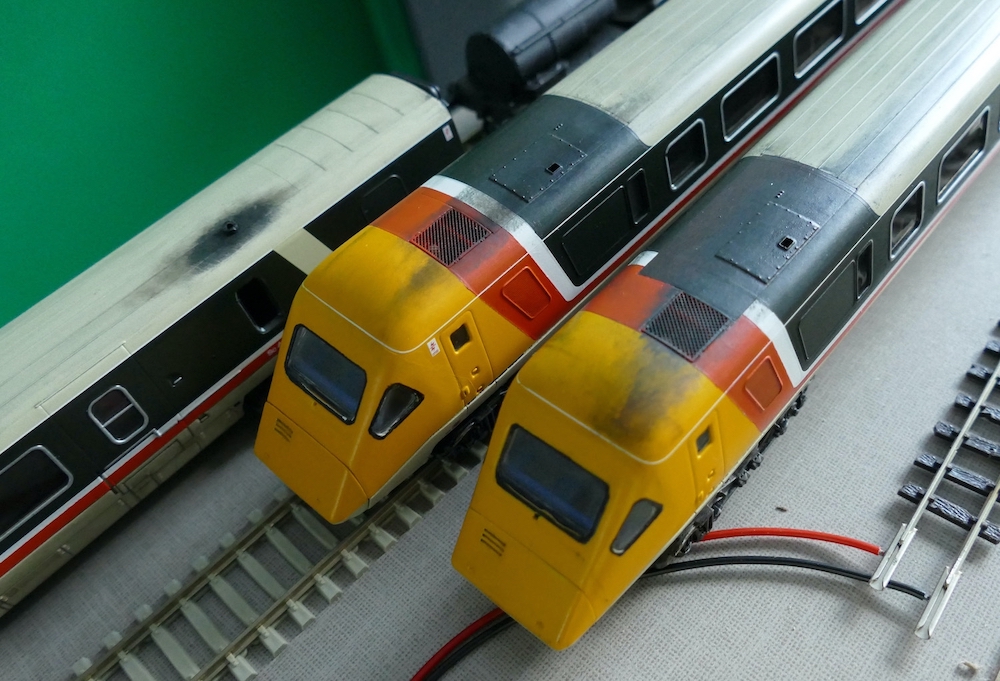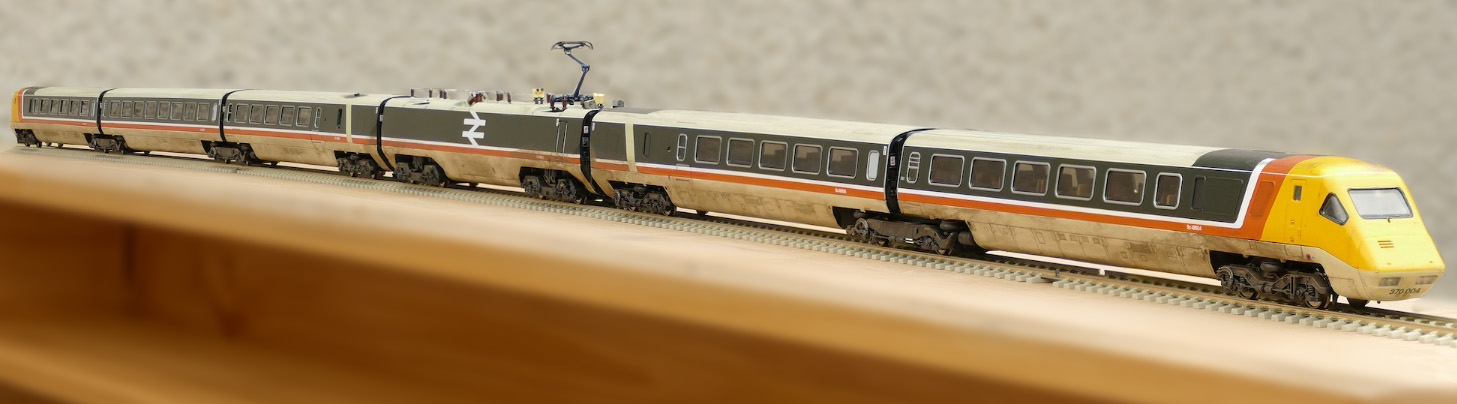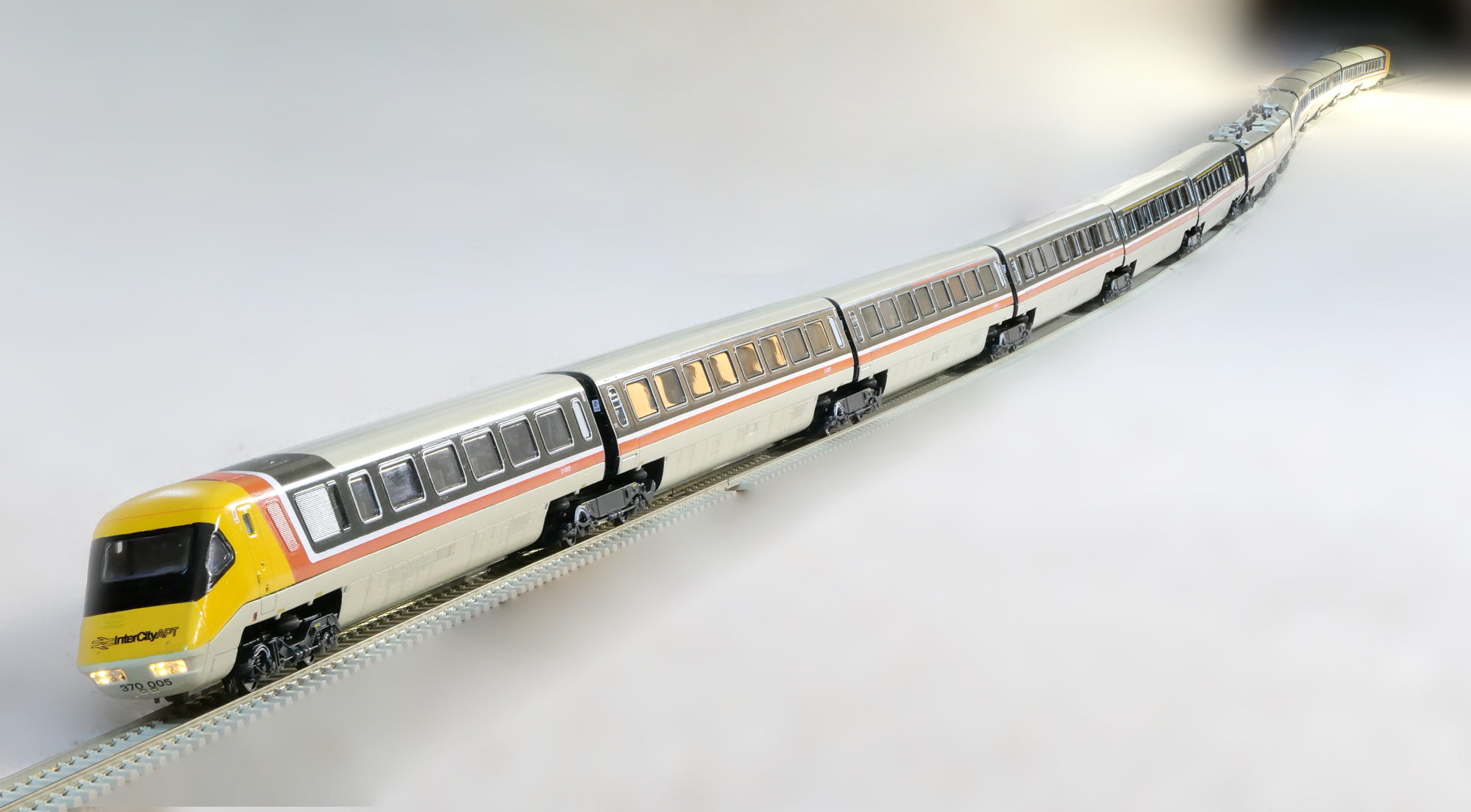
Trailer Rake 5 (aka 370005) had an interesting early history. Before it was formed up into a full-length rake, and perhaps before it was even commissioned, four cars were purloined from the APT test yard at Derby and tripped over to the Railway Technical Centre. There, around 31st October 1979, they were given the once-over by the chairman of the Chinese Communist Party, Hua Guofeng (successor to the infamous Chairman Mao), who was on a state visit at the time. Whether his exposure to the APT inspired the Chinese high speed rail developments 40 years later is still hotly debated...
Around this time, 005's DTS 48105 was subject to some livery experiments. While orange cantrail stripes were not ubiquitous by this date, it appears that the trend towards the orange stripe was gathering pace. While all the other APT units featured a white cantrail stripe at the top edge of the dark grey band, 370005 was given an orange one, which was affixed slightly higher, a few inches above the dark grey. It was also discontinuous, being broken at the divide between each colour band at the cab ends. The scheme appears not to have found favour - by the time the unit was operational the standard white cantrail (on the sides) had been applied, with orange only around the yellow ends and red stripes.

This was not the only livery modification trialled. Units 001 to 004 had all emerged and operated without any 1st class yellow or buffet red stripes on the respective vehicles, which was perhaps the original intention (and arguably unnecessary for a fully-reserved-seating passenger operation, as passengers just would board by coach letter). However it looks like BR had second thoughts, because as well as the cantrail, 48105 was also given a red buffet car band above four of the passenger windows. Again this was painted out on the DTS before entering operational service, but units 005 to 007 all entered traffic with these bands applied to the appropriate vehicles.
Photos of unit 005 being commissioned have so far escaped my research, and so the first time the unit is seen is on 18th April 1980, operating with power car 49006, and paired with 370001 on the rear. The occasion was a VIP run from Glasgow, but all did not go to plan. As the train was passing Yealand, north of Carnforth, the rear axle of the bogie between the TS and TRSB cars came apart at high speed. The APT-P Chief Design Engineer, David Boocock, was riding on the train, became aware of the problem, and operated the communication cord. Fortunately the train came to a stand in line with the track, with no passenger or staff injuries and little other damage to train or tracks. Naturally all the P-trains were immediately withdrawn for axle checks.
Interestingly, this run is currently the only one I have been able to identify which features a full-length unit with a full yellow end. At the time of writing, I've not seen any evidence of a full 12+2 APT in this condition - and certainly this never happened with vehicles without their class and buffet bands!
A few months later 370005 was back in traffic, now with a black mask, and paired with similarly-attired full-length 370006. Together with power cars 49002 and 49004, they formed the first identified operation of a full 12+2 APT-P set, recorded around 28th July 1980.
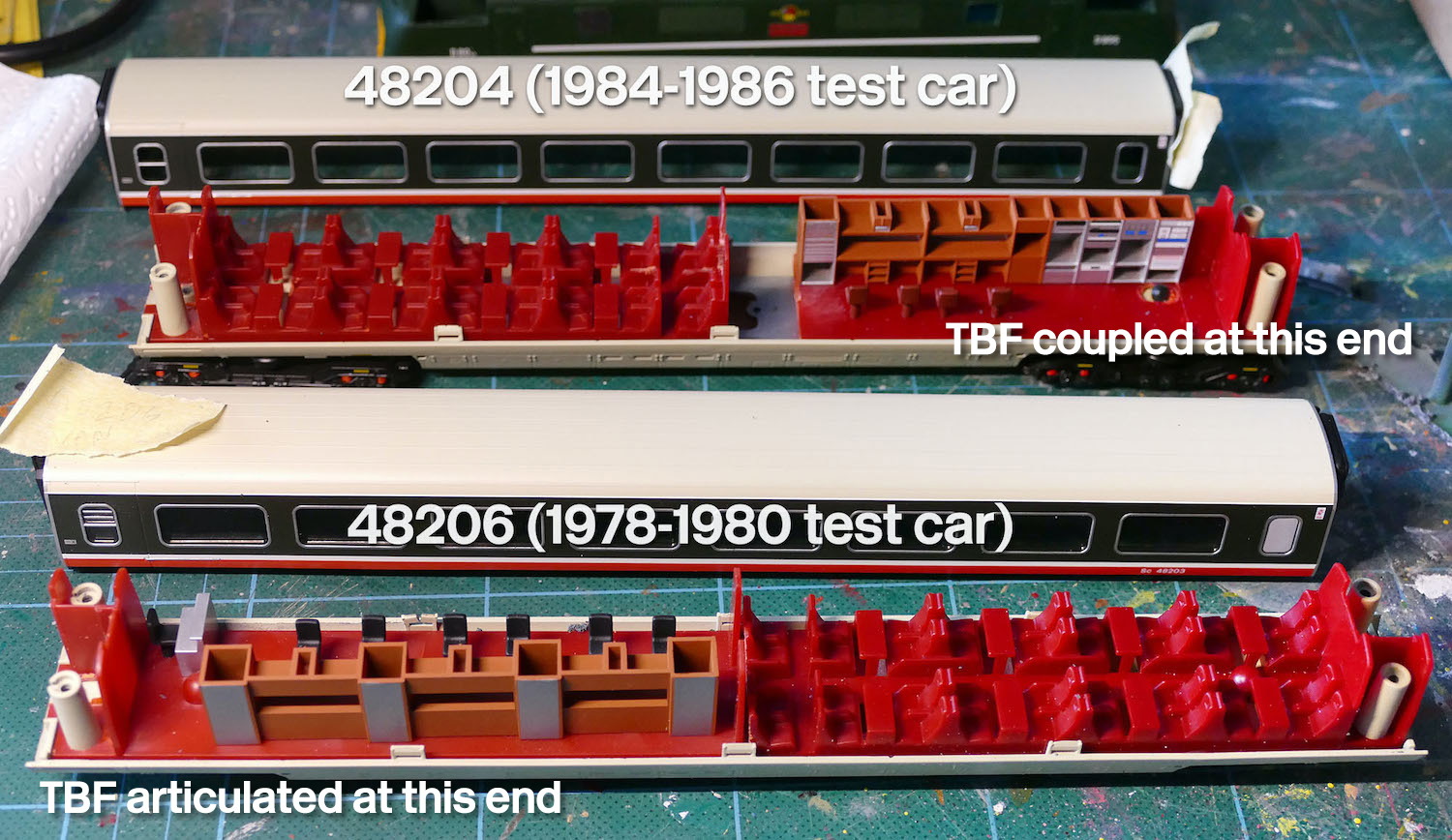
As a full length unit, 370005 seems to have been relatively short-lived. The latest instance I've found of it running in this condition is in December 1980, after which it seems to vanish until November 1982, when it reappears as a two car rake. Possibly at the same time, or perhaps a little later, it was part of a three-way TBF-swap, receiving 48606 from 006, while its original brake vehicle 48105 ended up in 370002.
It remained in this form for the rest of its operational life. Sometime in early 1983 it lost its original nose cone, and received one from 370002 - the old unit number remained clearly visible under "370005". Notable highlights included the 1983 very high speed, 150mph-plus, pantograph test runs, paired with two-car 370006 and two power cars - rumour has it that this test train could easily have broken another UK rail speed record, however engineers were concerned that the resulting overhead wire uplift might be sufficient to strike overbridges on the northern WCML. Sadly the APT did not get a chance to break its own record.
The unit appears to have been the spare short-end for APT's 1984 return to passenger service, but does not seem to have been called up for use, aside from early trials before the service recommenced. Its last appearance was at Wolverton Works open day in August 1985, after which it was dumped at Crewe ETD as a spares donor. Moved to Derby in 1987 it was cut up with 001 later that year, in the same yard that this story began eight years earlier.
Like 005, there is little evidence of commissioning runs for 370006. Photos of the rake with a full yellow end are currently confined to the test yard at Derby, and its first appearance on the main line (at least as currently available on the internet) is as a full length 12+2 set, with a black mask, paired with 005 in July 1980. As the first full 12+2 APT-P, it was used extensively for testing (as well as publicity filming) over the next 18 months, and was also seen paired with full-length 007 and two-car 001.
006's star turn came on 7th December 1981, when it became the first unit to carry fare-paying, non-BR-staff passengers, as BR launched the APT into some very bad weather indeed. Paired with two-car 002 (which was not accessible to passengers) the set formed the inaugural service from Glasgow to London and back. The excesses of the travelling press and the efficiency of the tilt system have been widely reported elsewhere. Of course, four days later, freezing conditions saw even more bad news for the APT, and perhaps marked the beginning of the end, as 006 and 002 failed with frozen air lines.
006 remained as a full length unit throughout 1982, operating numerous test runs, before being dragged from Glasgow to Derby on 16/17th March 1983 via the S&C. There it was reduced to two cars - reappearing in May 1983 possibly with original TBF 48606, but certainly shortly thereafter gaining 48602 in the three-way TBF-swap mentioned above.
With AC EMUs, convention had it that the unit number was denoted by the motor brake vehicle of a set. Thus if a set had say a driving trailer swap, the unit number carried by that driving trailer would be changed to that of the motor brake. While APT trailer rakes didn't have a motor brake, it appears that, very briefly in June and July 1983, the conventions was applied via the trailer brake, as 48106's unit number (now paired with TBF 48602) was changed to 370002. A handful of photos show a crudely painted "2" on the rake's nose end, with a clearly visible "6" underneath! At the same time, the original APT logo on 48106's nose was replaced with an all-black, infilled version, seemingly made from standard Rail Alphabet lettering and logos. By August, the unit number on 48106 was once again 370006 - looks like the APT got its own convention of the unit number following that of the DTS - no other APT units went through this confusion!
In two car form, 006 went on to operate test trains throughout 1983, including the very high speed pantograph test runs with two-car 005. However in early 1984 it was paired with 007 in preparation for the resumption of public services. Just ahead of this, it was one of three units sent to Heaton for high-speed propelling and coasting tests on the East Coast Main Line in July and the first few days of August 1984. The DTS was shorn of its nose cone and coupled to pairs of Class 37s which would propel it and another rake (003 or 007 were both used for the outer end of the set) up to around 100mph before releasing and coasting.
Immediately after these unusual operations, 006 re-entered public service (albeit locked out of use), on 4th August 1984, again paired with full-length, passenger-carrying 007. It continued in service until around the end of December 1984 when it was replaced by three-car 003. Disappearing for a while, it was moved to Crewe ETD for storage by the end of 1985.
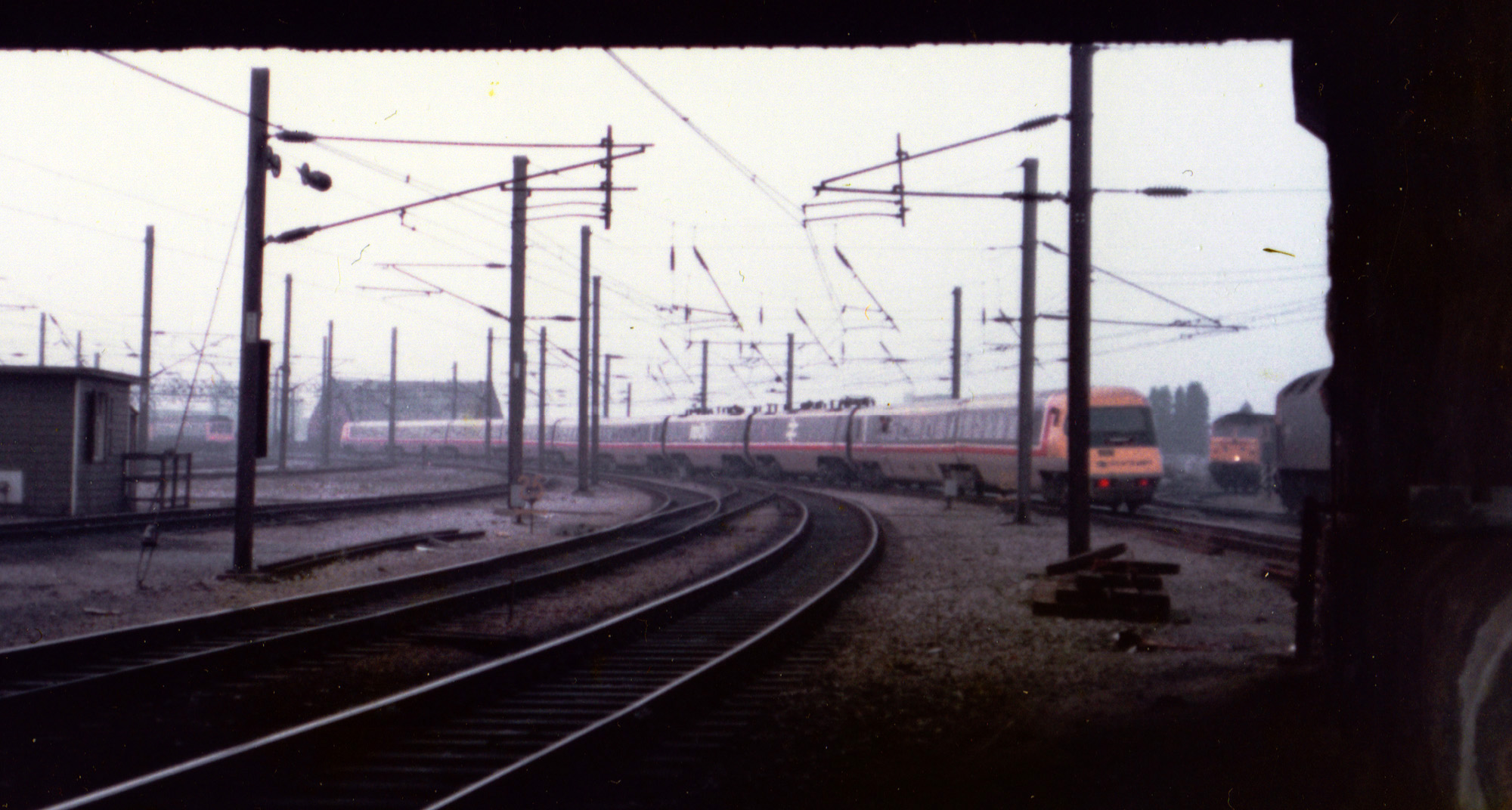
370006 at the rear, departing Preston on 22nd August 1984.
In April 1986 006 was returned to use paired with the test unit combo of 370001, the non-articulated test car 48204, and power car 49005, operating on test trains for some time, and gaining the Crewe ETD red stripe around the nose. By August 1986 it was paired with 370003 and power cars 49002 and 49006, in which formation it was withdrawn and stored. Of course, the rest is history, as this final pairing survived into preservation at Crewe Heritage Centre.
The starting point for both units was a Hornby 2020 R3874 7-car set with the black mask, with a full complement of trailer car packs (TS and TUs from the 2020 batch, and TRSB/TFs from the 2023 release).
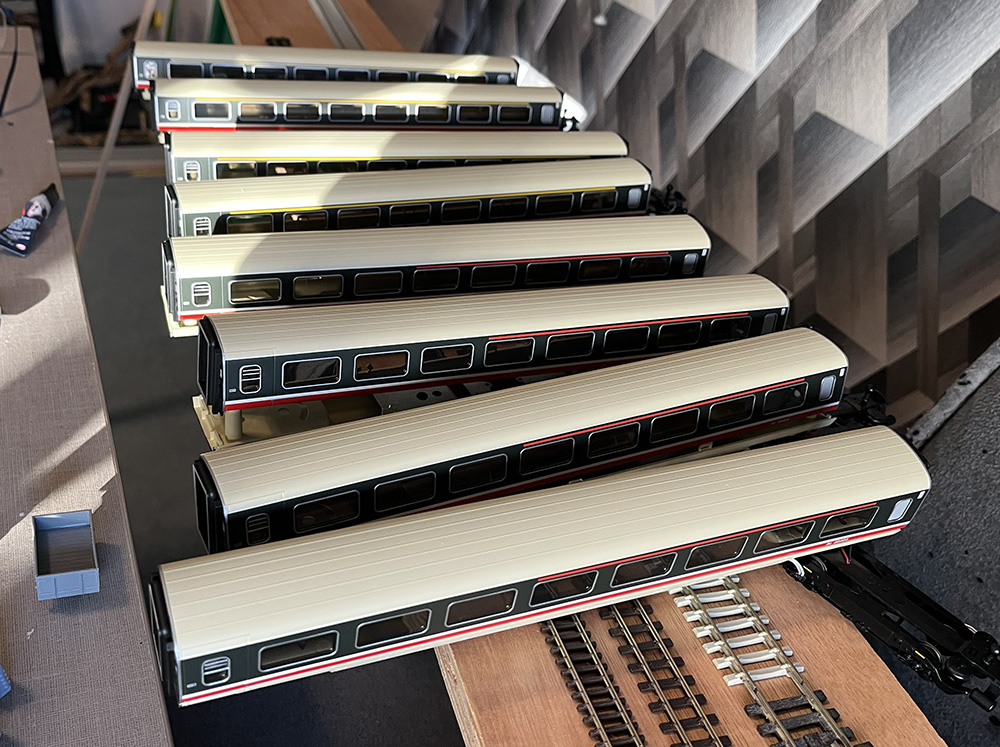
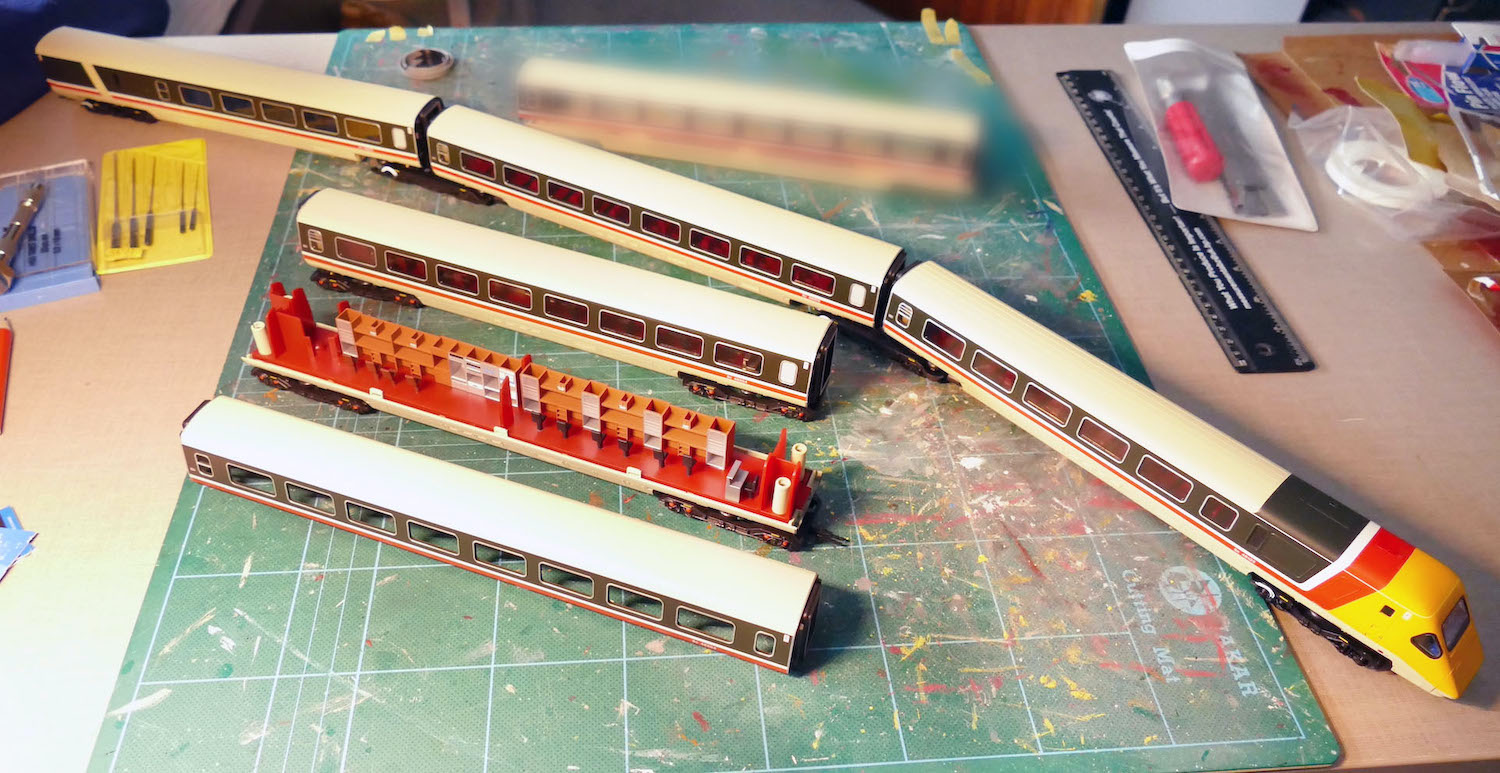
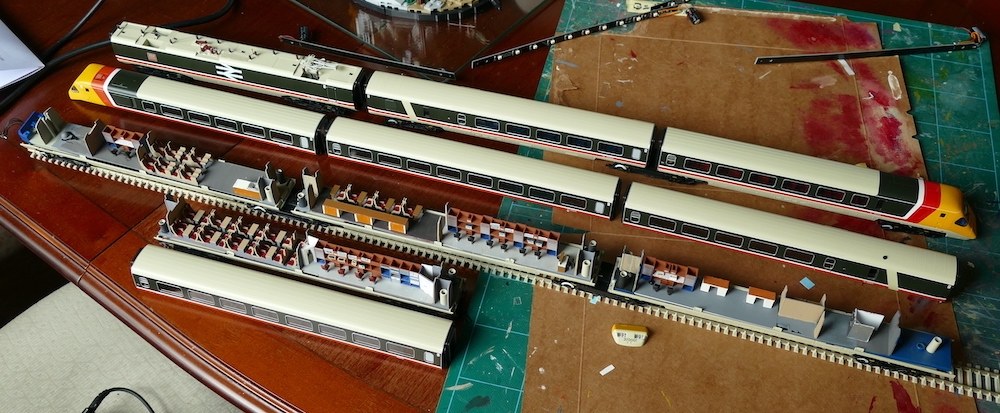
Naturally the first step for all 12 trailer cars is to dismantle!
External modifications
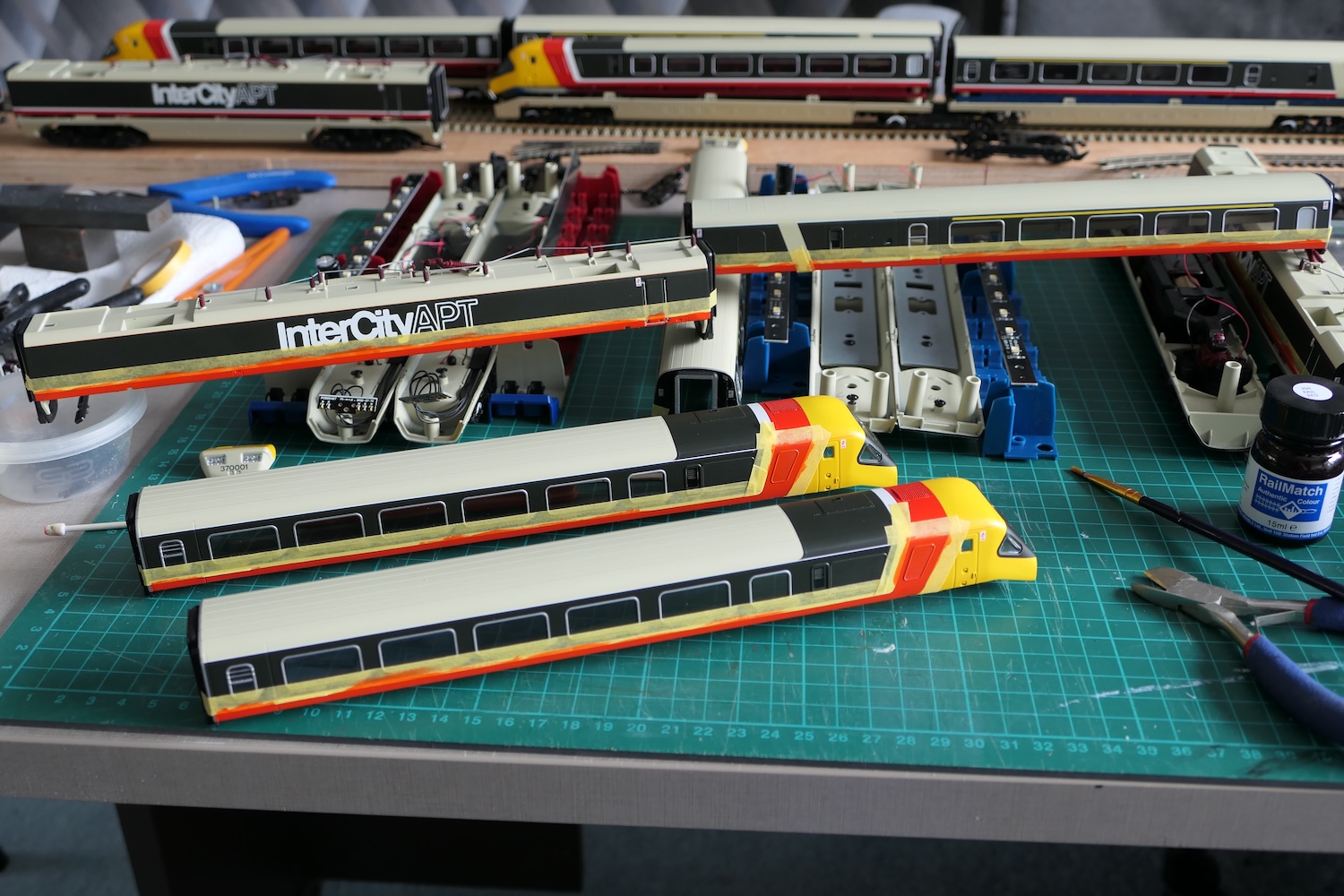
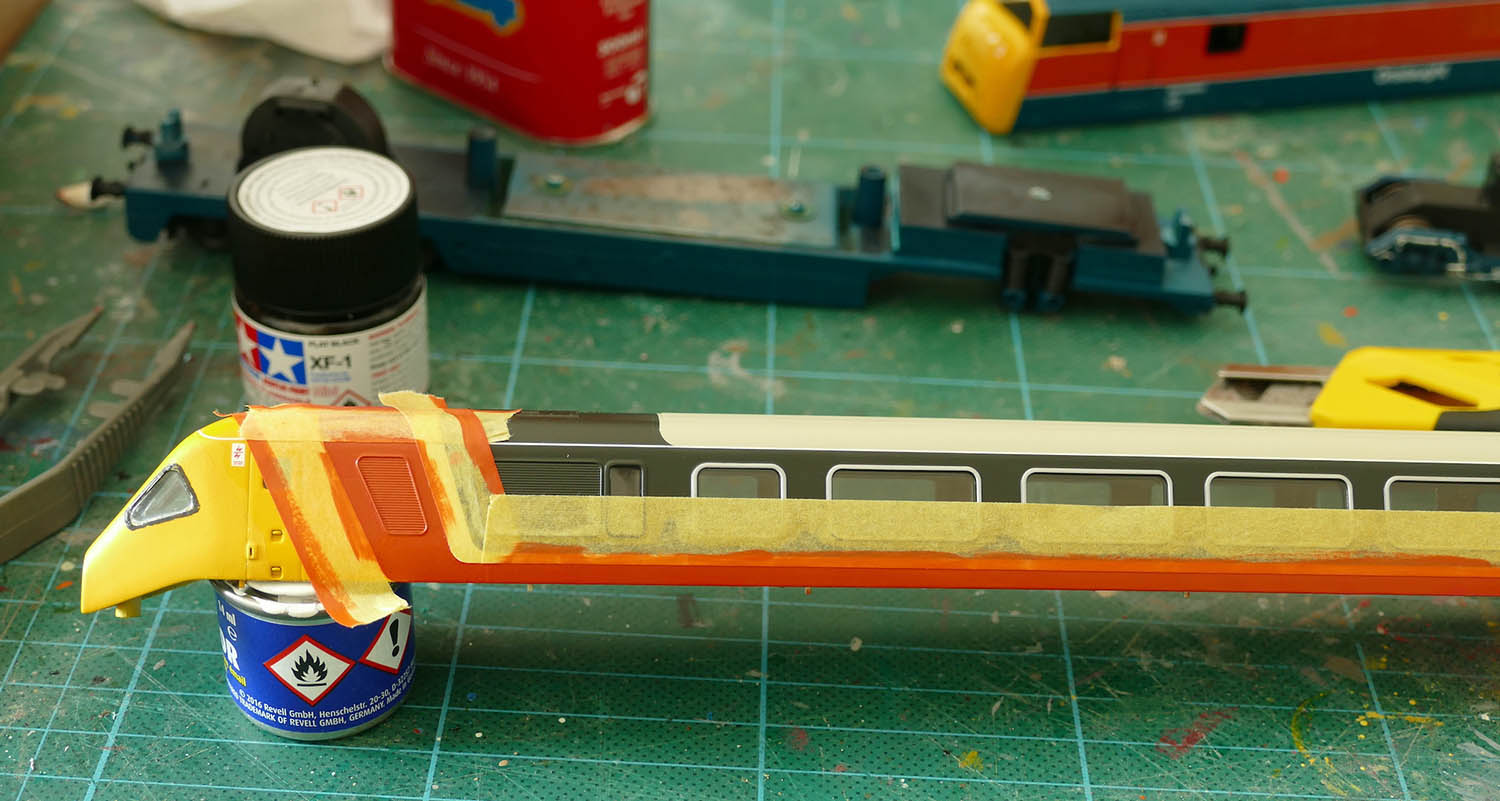
Having committed to repainting all the red stripes on 001 and 004, the same had to follow for 005 and 006. After removing the running numbers from the stripes with a gentle application of T-Cut, the Hornby red was carefully masked and then overpainted with Rail Red.
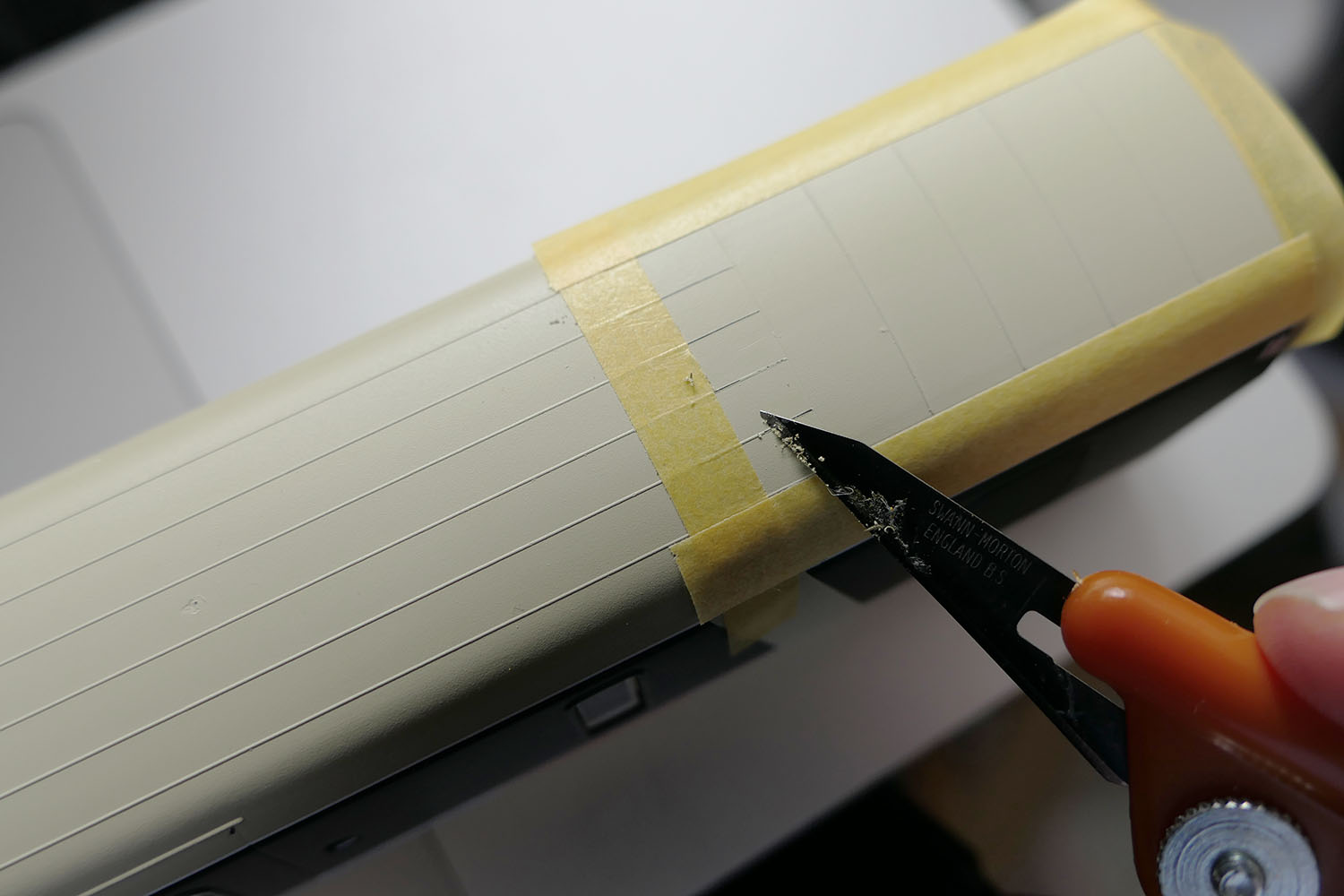
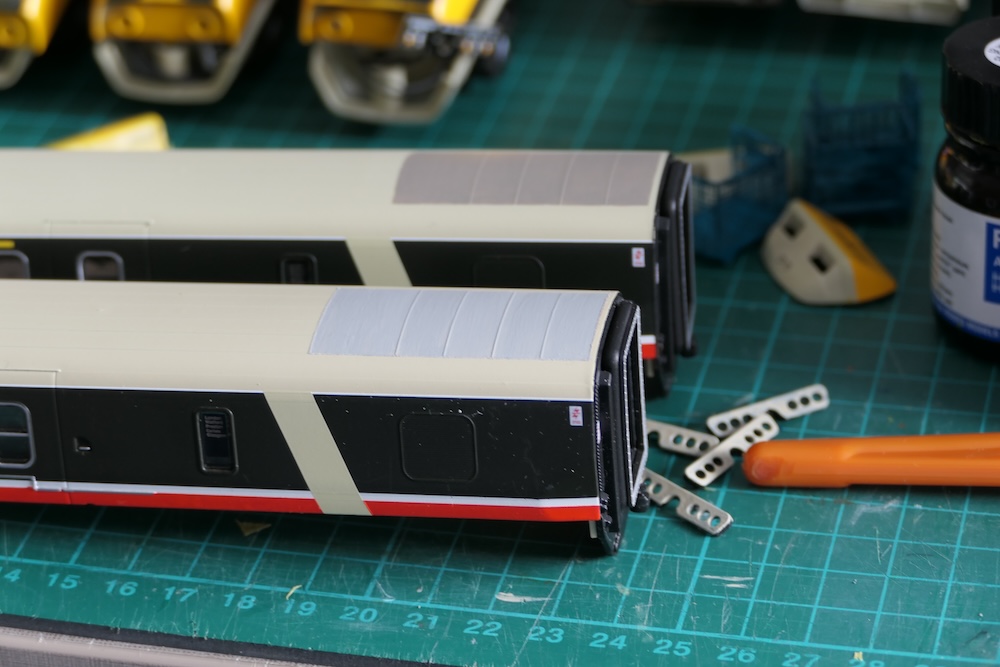
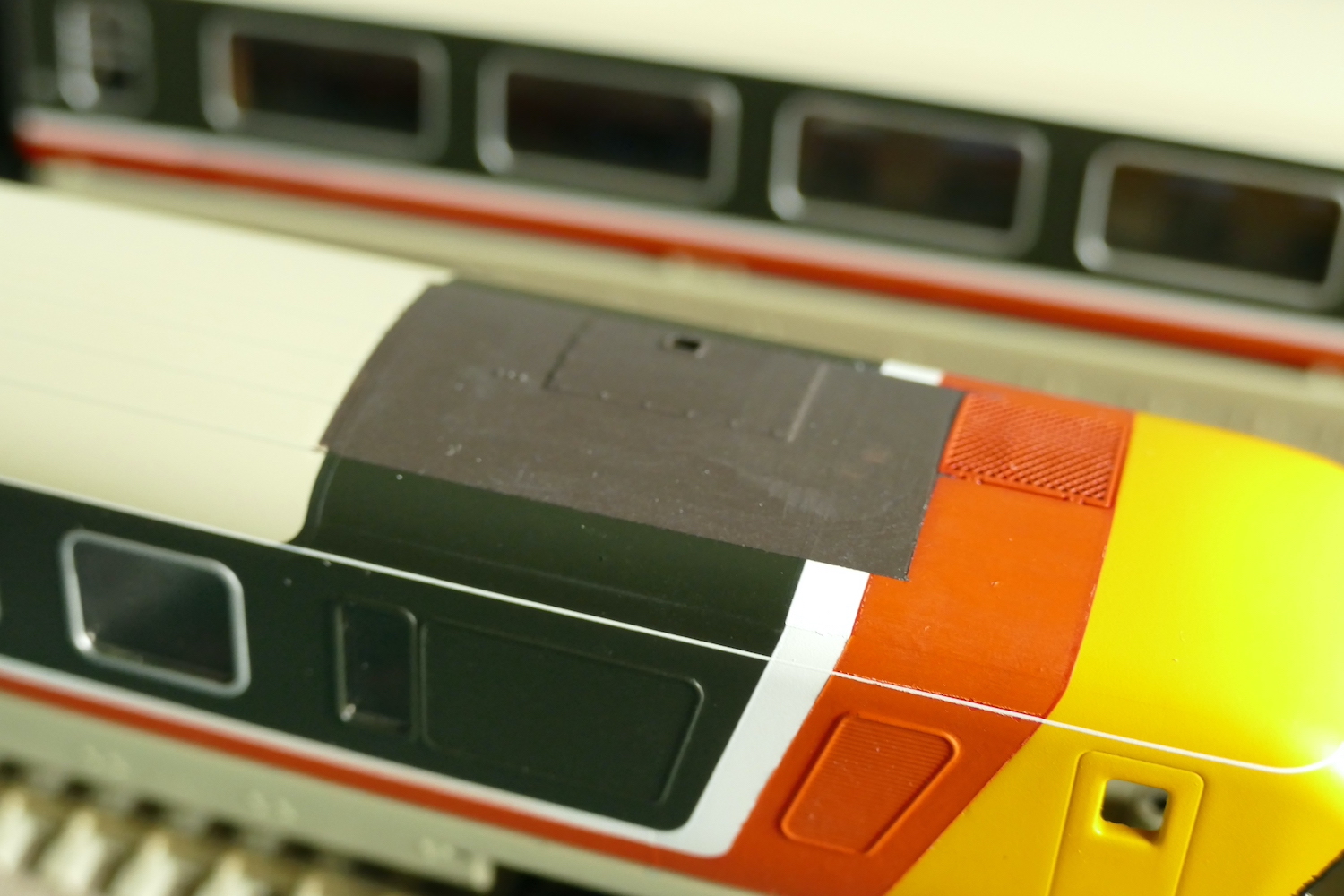
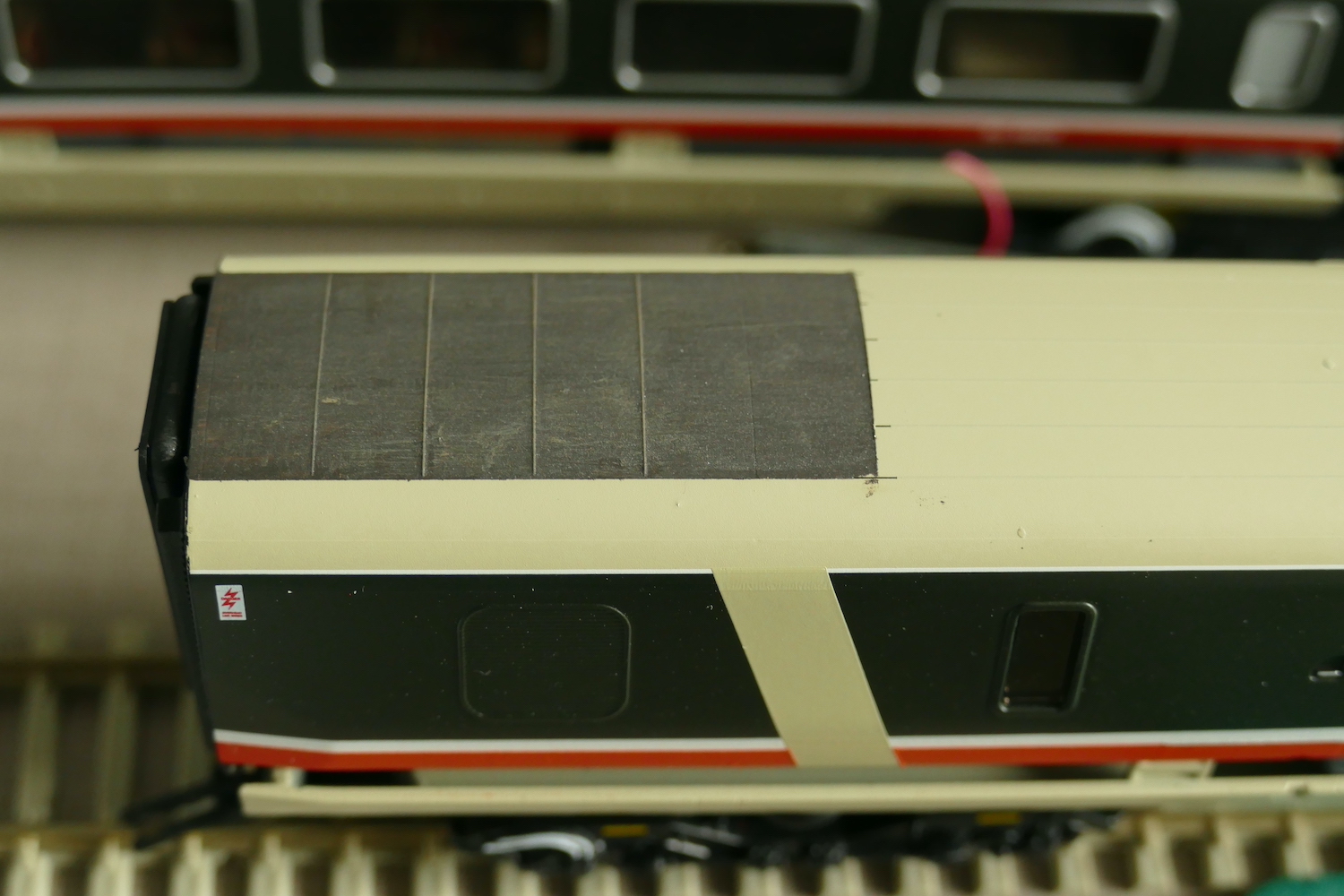
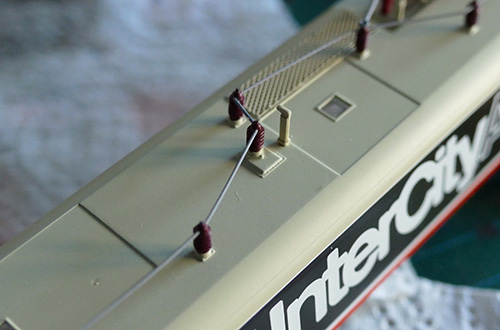
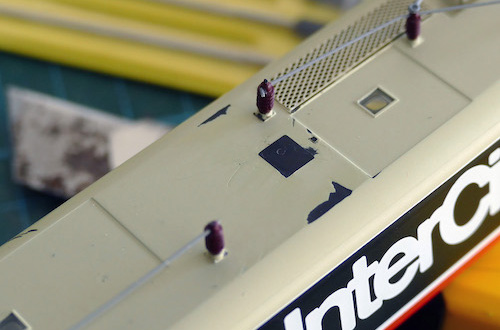
Both TBF cars had differently-coloured roof panels over the MA-set area adjacent to the power cars. This area is slightly longer than shown on the model, so once again, some of the moulded ribs on the roof were carefully cut away before masking and painting. The colours used are an approximate best guess, based on the handful of photos available.
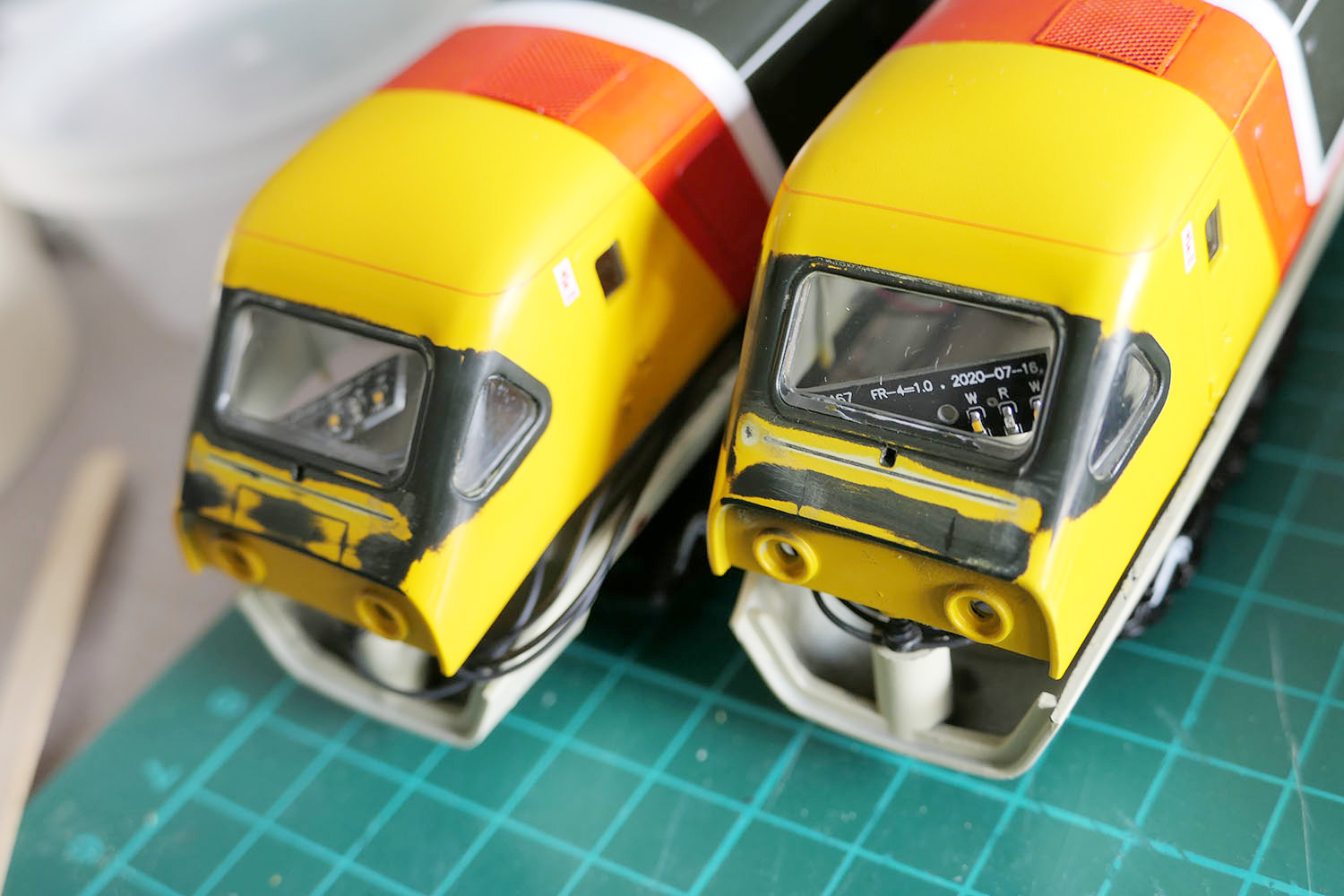
In 1980, both units' noses had yet to be fitted with a rain strip below the windscreen, so this was removed and the nose filed flat. As with 001 and 004, the raised moulding around the horn grille was also filed back flush, as per the prototype.
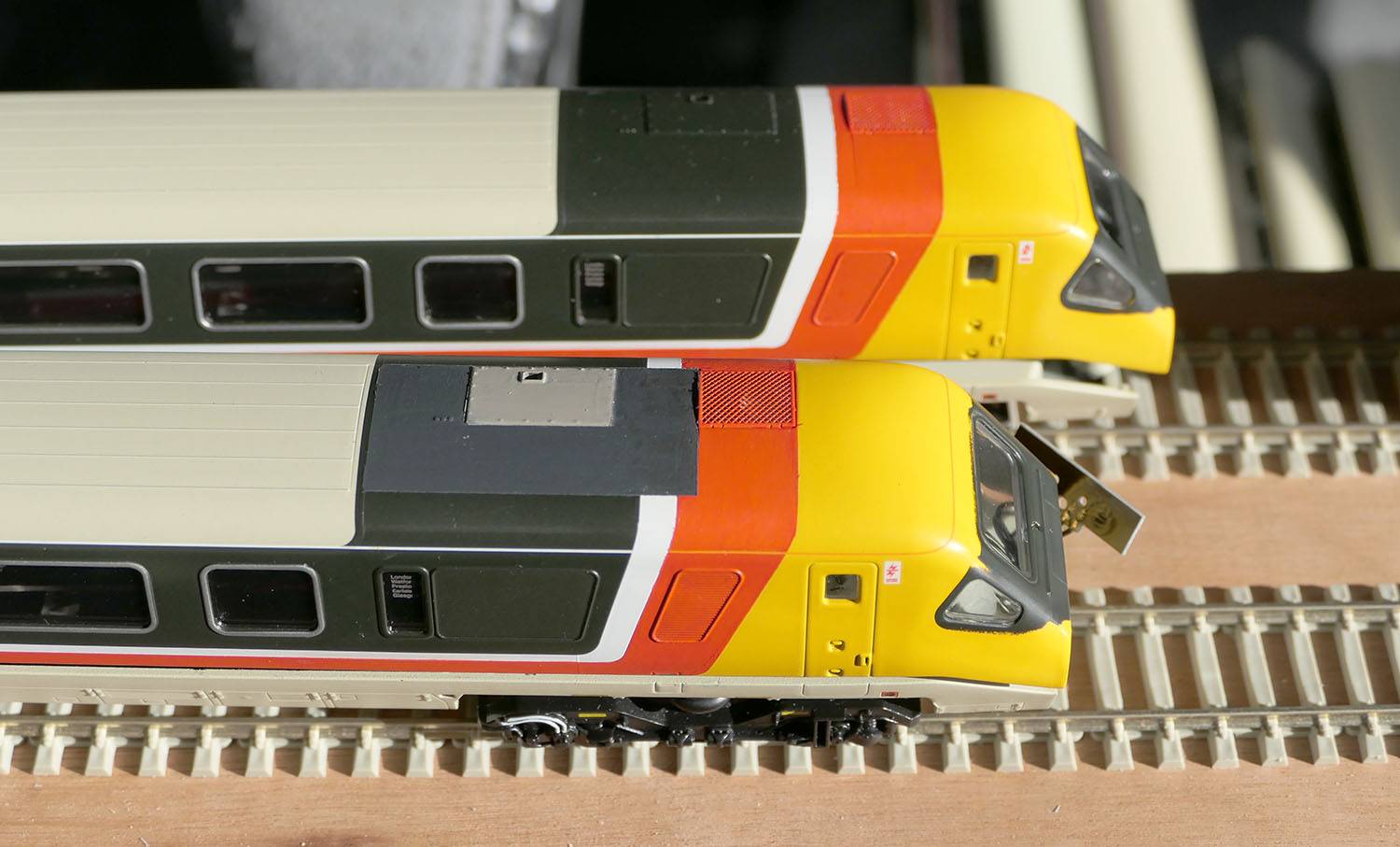
Up on the roof, 48105's diesel alternator roof panels were, like 48104's, unpainted, or maybe bare metal, or something; whatever the case, it hadn't been finished to match the rest of the bodywork and stripes. Here two shades of grey approximate for the finish visible in some photos.
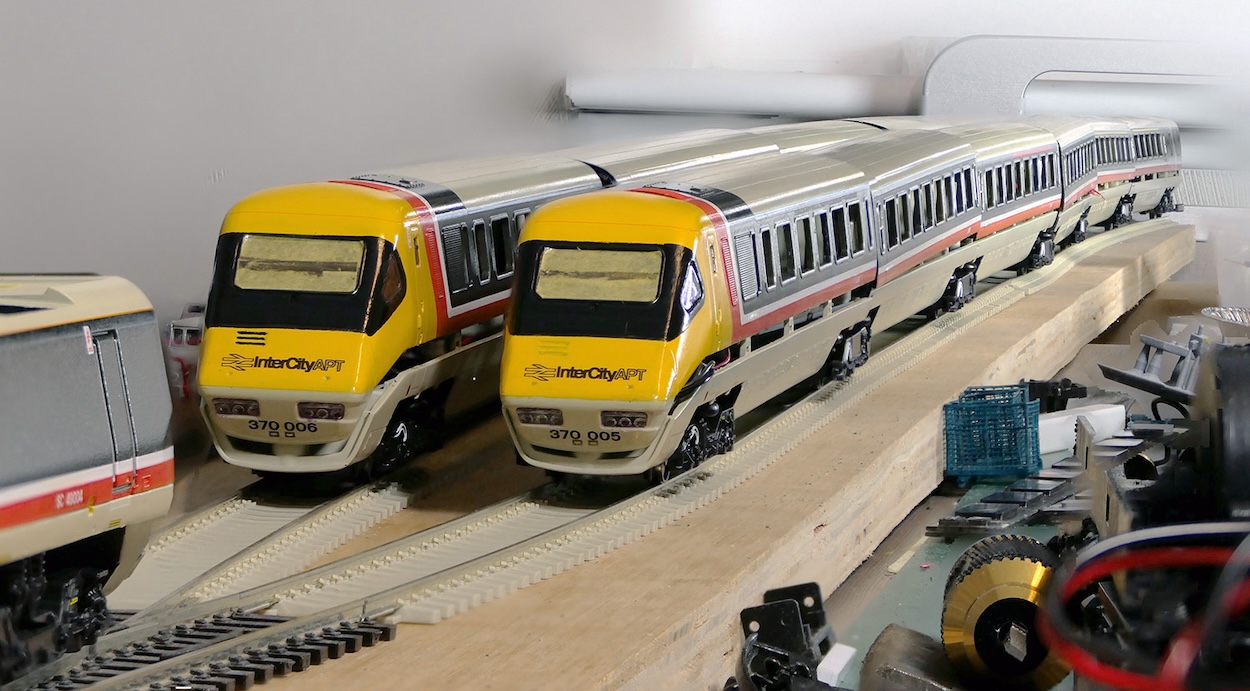
As detailed in the main "Faces and Formations" page, the black masks applied to the various DTS vehicles varied in size and shape across the fleet. 005 and 006 had the two lowest-topped masks, and both featured distinctive lower-edge shapes.
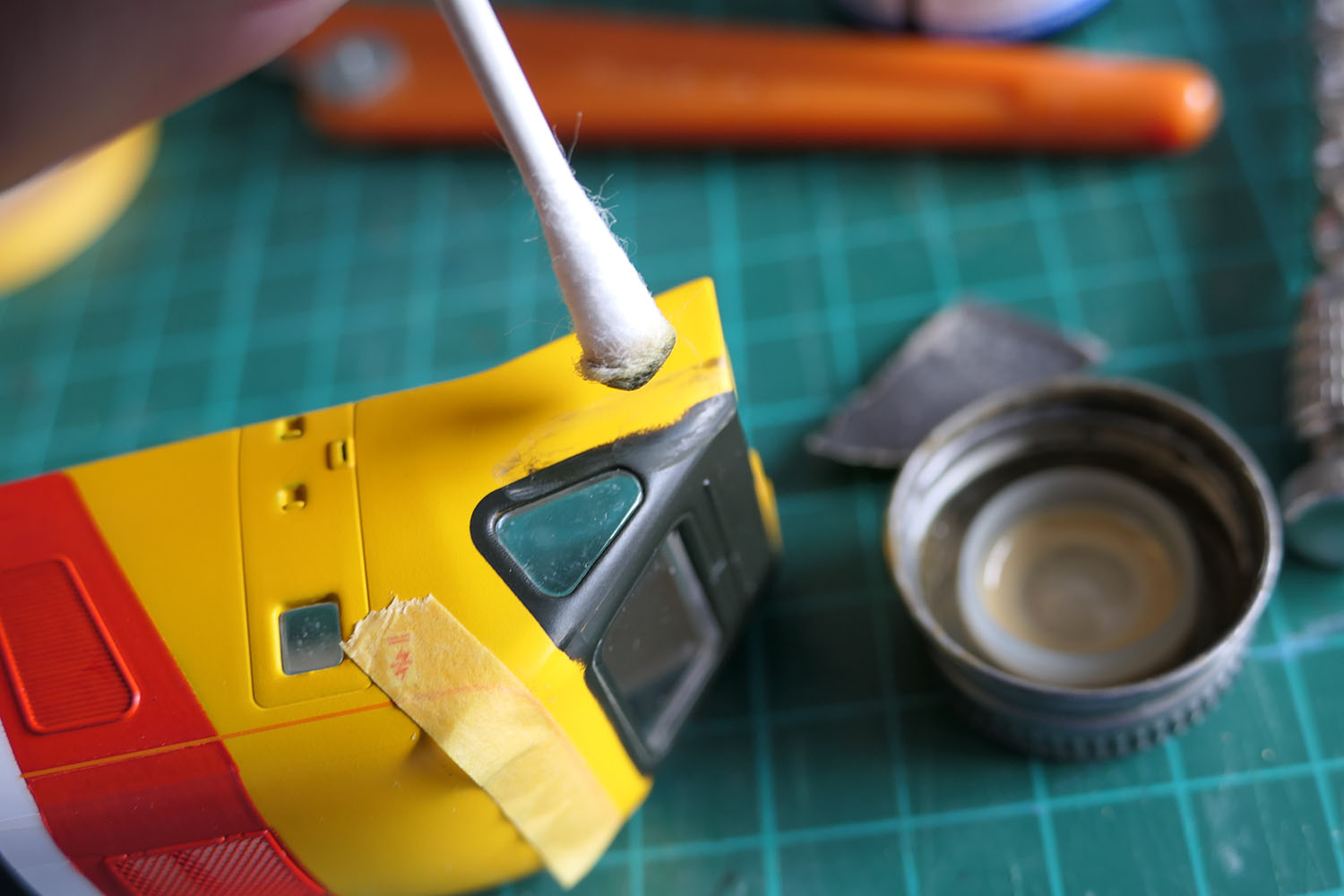
To adjust the Hornby masks, first up, a gentle application of T-Cut was made to soften/remove the edges of the mask above and below the windows as appropriate. This exposed the underlying warning yellow where necessary (such as above the windscreens) and also removed any obvious paint-edges when over-painting the black later.
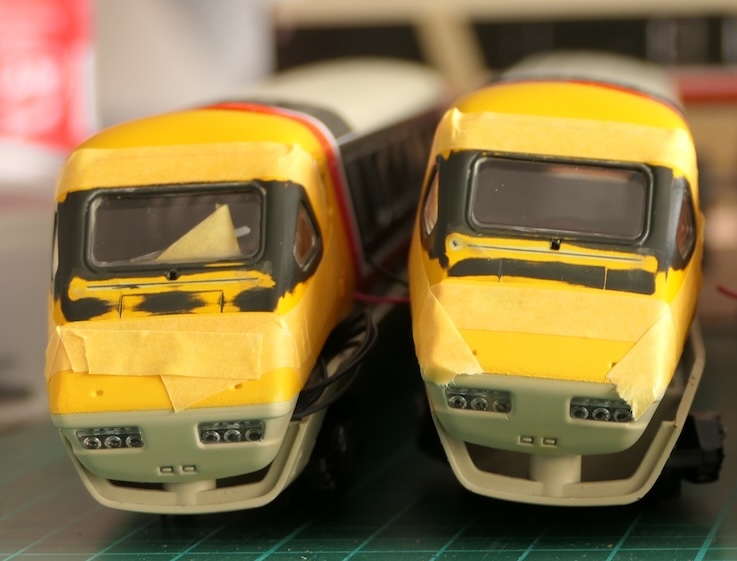
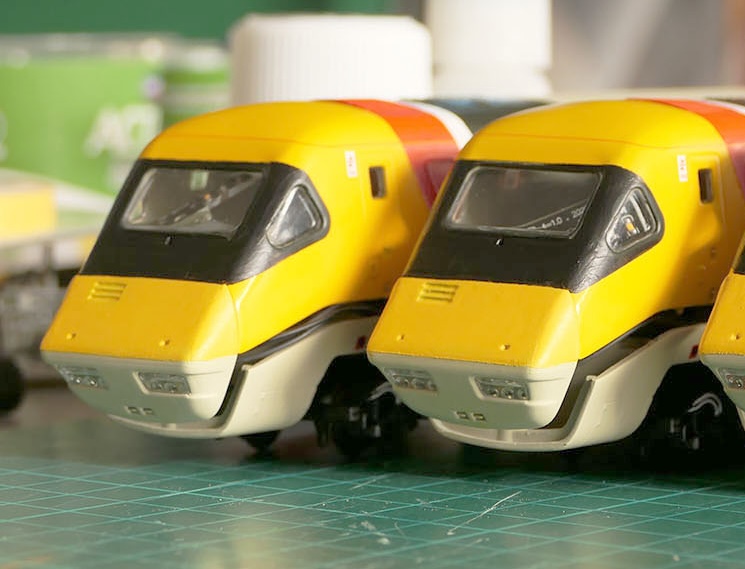
Masking was then applied and shaped as closely as possible to that of the prototypes, using reference photos from various angles. With a little bit of careful hand-shaping where the masking was too crude, the slight lower-corner "droops" are captured reasonably well, and the subtle top-edge difference between 005 (left) and 006 (right) can just about be discerned!
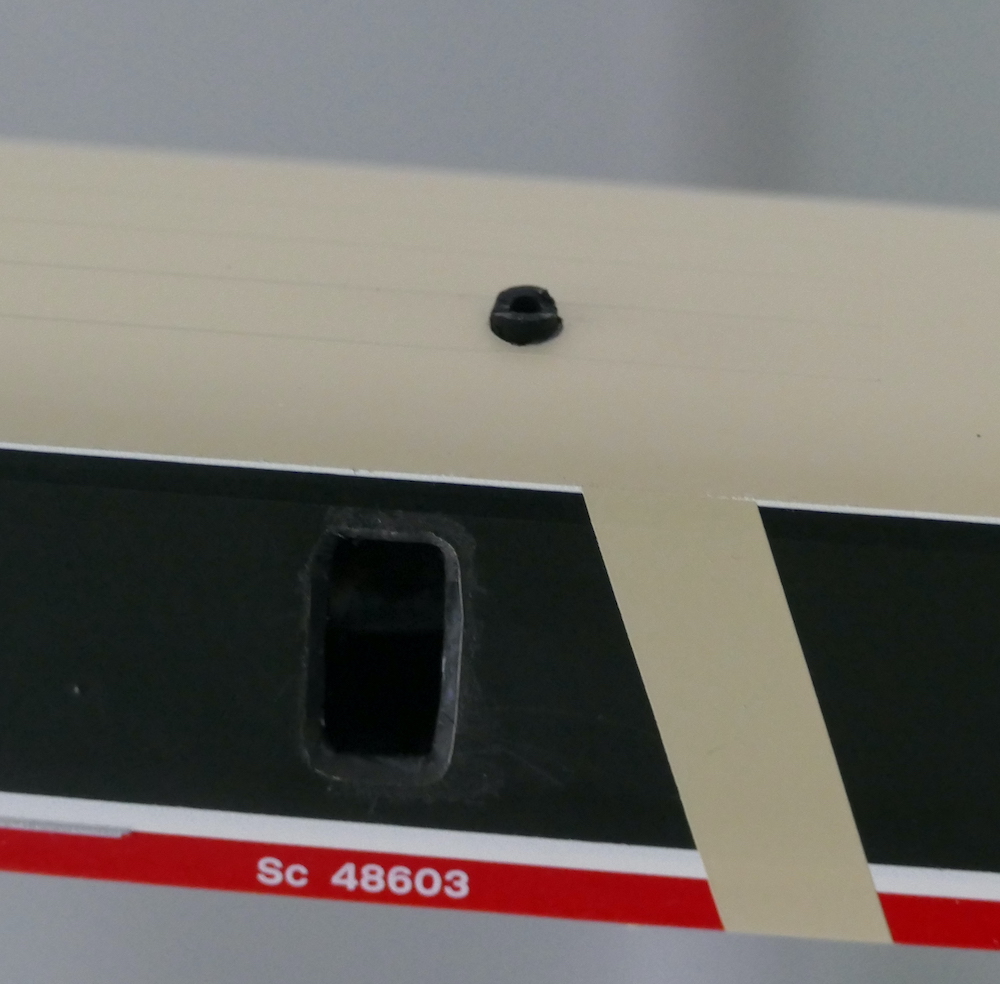
While the intermediate trailer underframe equipment was more or less identical across all four vehicle types, there was a slight difference on the underframe equipment of the buffet cars. This took the form of a small opening to the left of the central grille. It's hard to discern the nature of this opening in photos - the surviving buffet car has a plain plate in the gap; some 1980s photos seem to show a grille - others not. For the purposes of these models, a grille has been assumed.
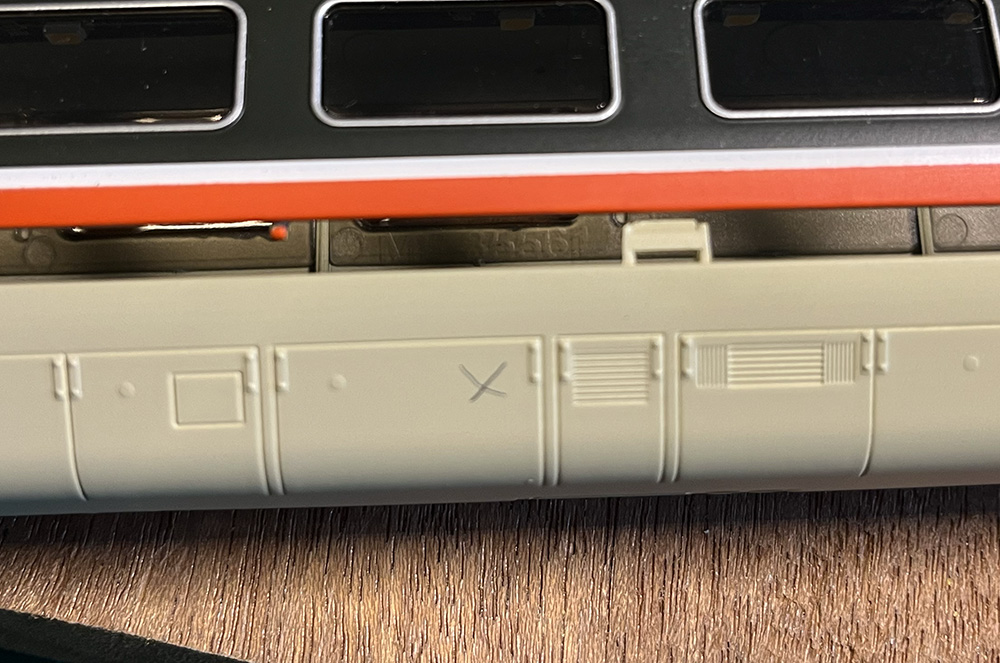
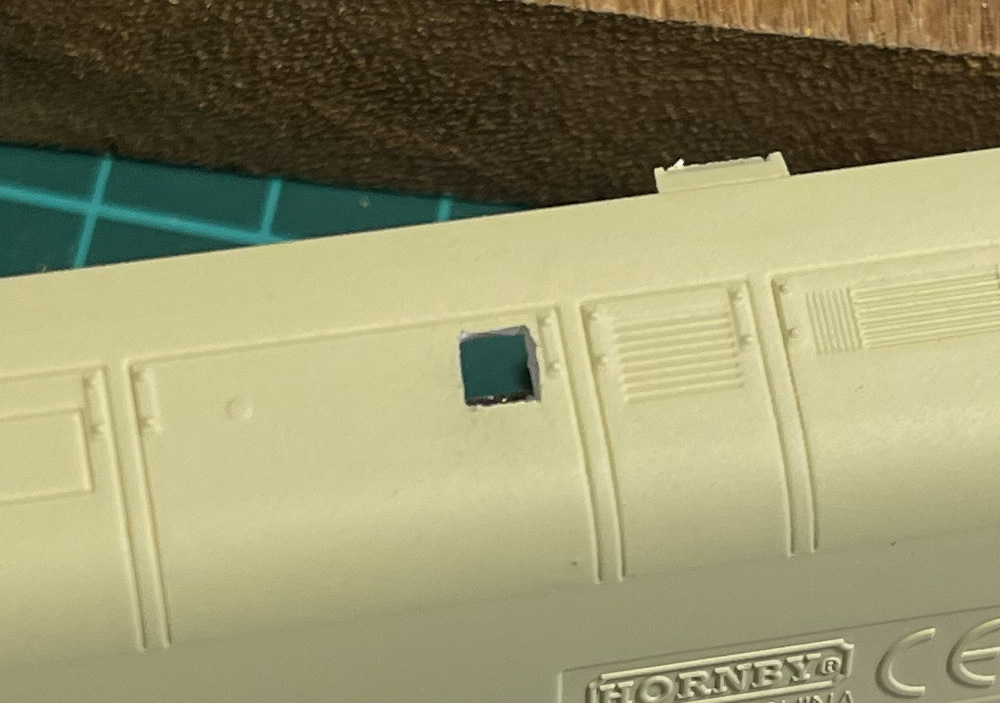
X marks the spot. The opening was drilled out, then filed to shape.
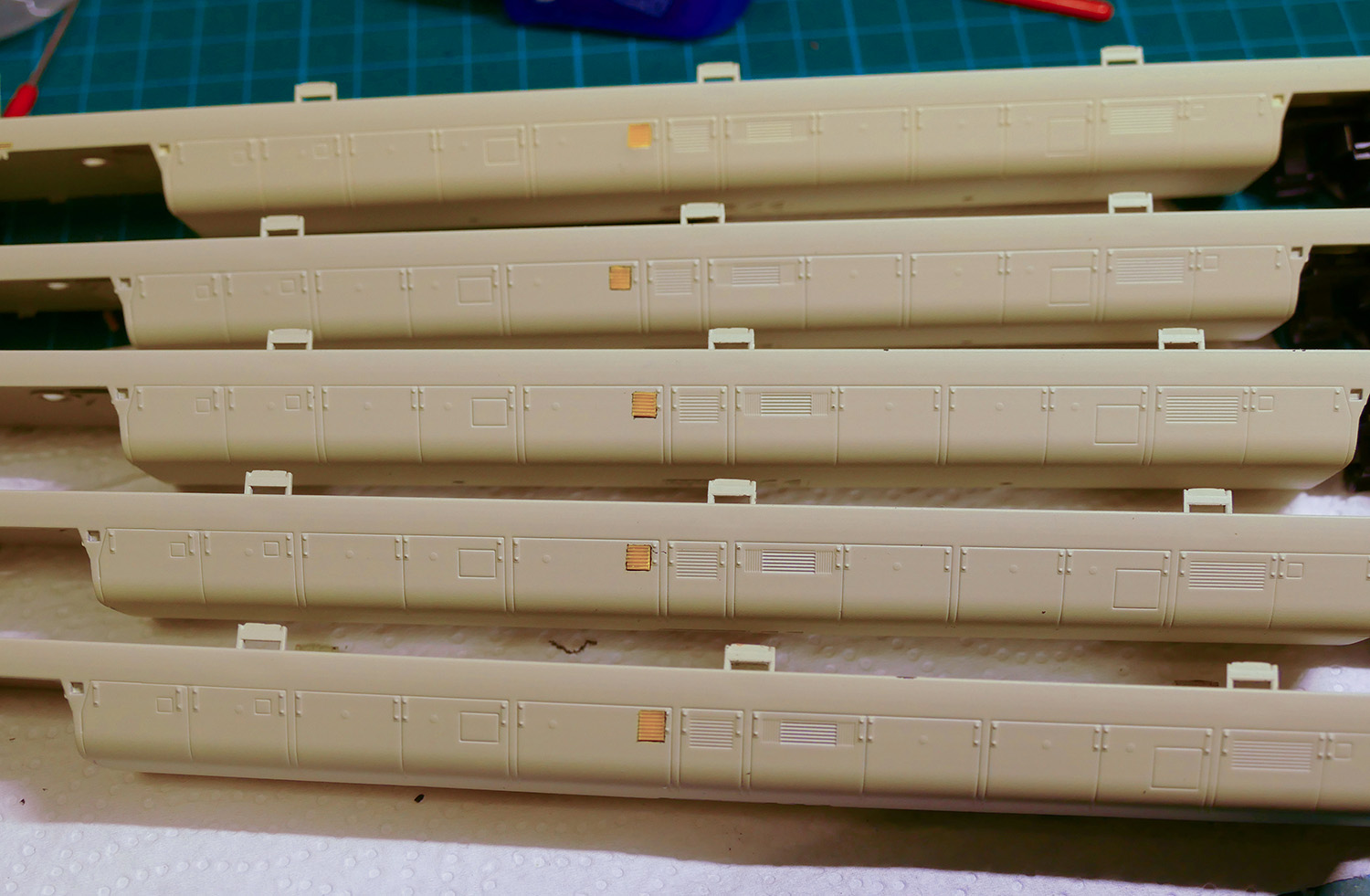
Spare grille sections from a Class 87 body were cut to shape and inserted, then painted with Executive Light Grey, which is a close approximation of the APT light grey colour.
Interior details
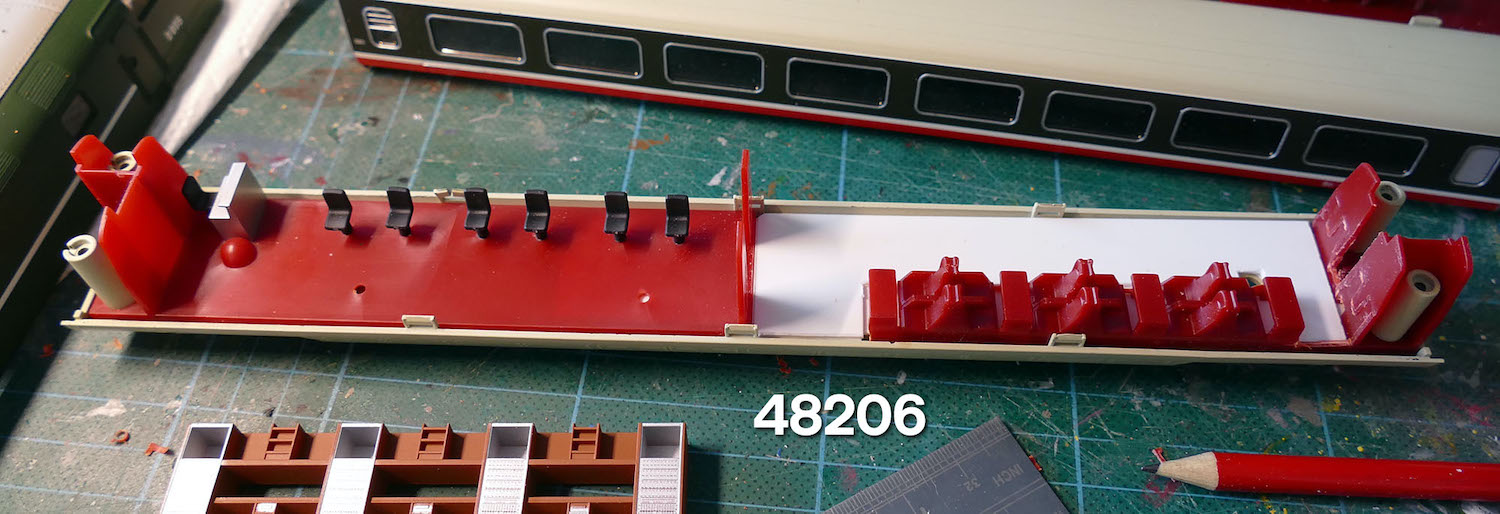
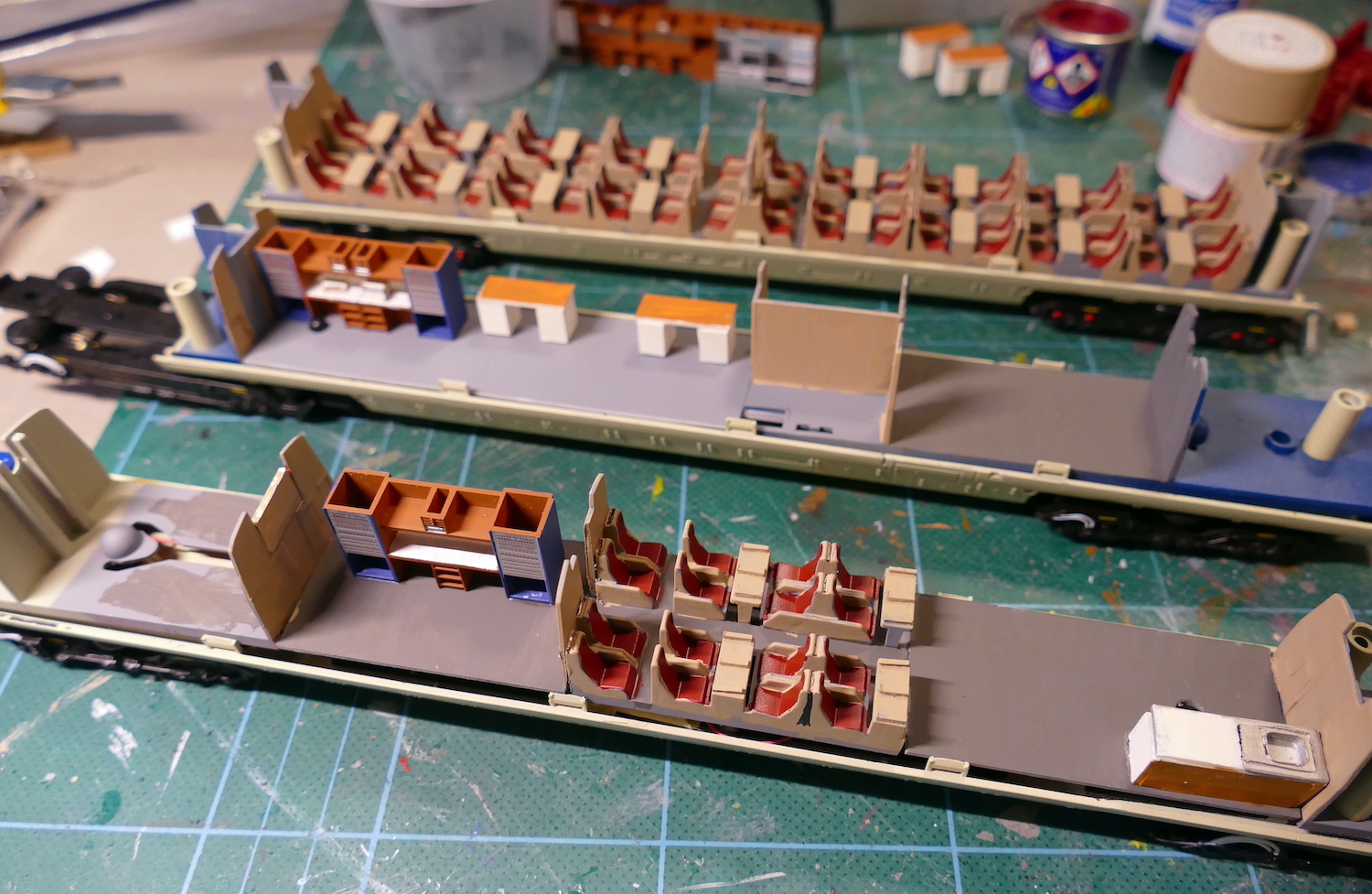
Unlike 370001 above, there aren't a lot of major changes to do to the structure of the interiors of the passenger vehicles, however the raw blue and red seat mouldings are somewhat garish through the windows, even without the internal lights on, so some effort was expended toning these down a bit!
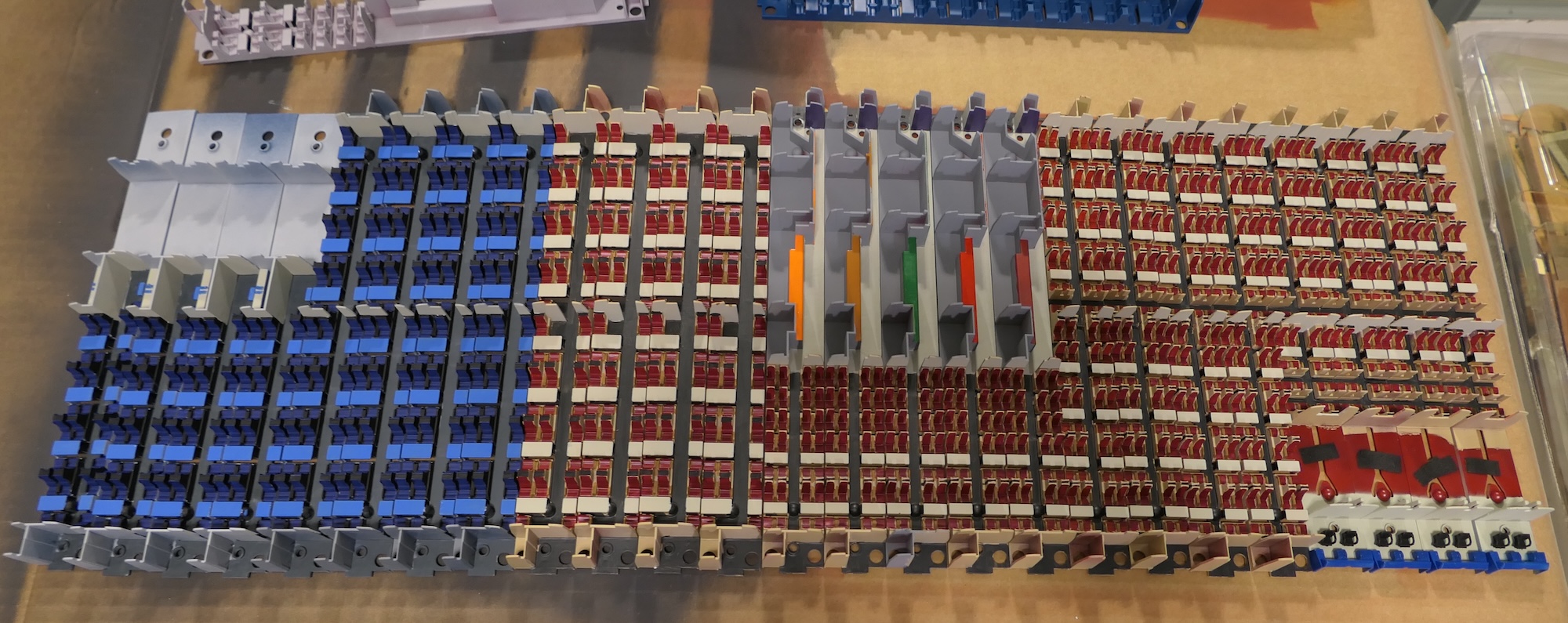
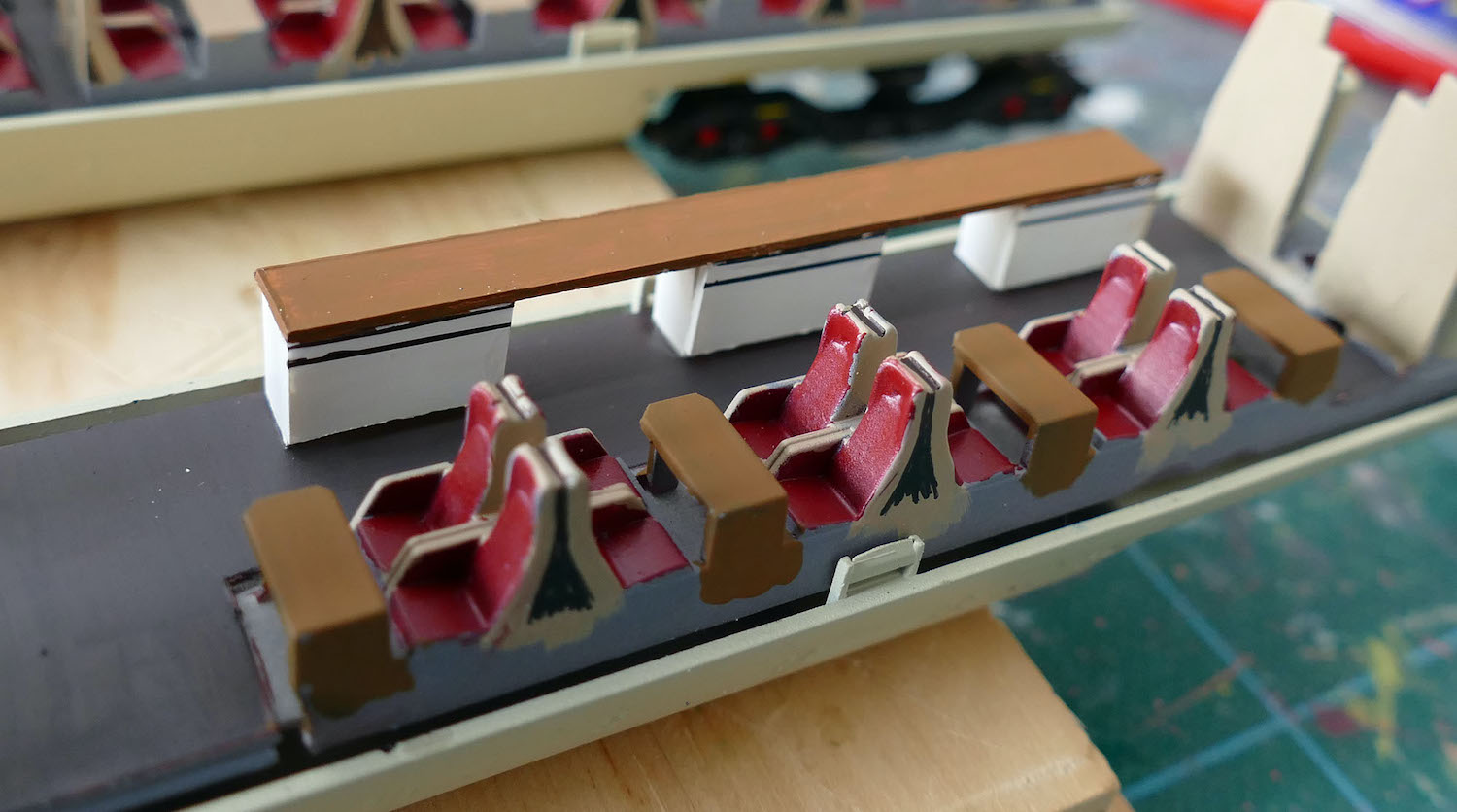
Though whether this counts as "toning down" may be a matter of opinion! The second class and unclassified vehicles were given a spray of a "tan" colour before being overpainted with dark red (standing in for the red tartan of the original), cream for the bulkheads, a darker brown to represent arm-rests, and black to make the shadows between seats.
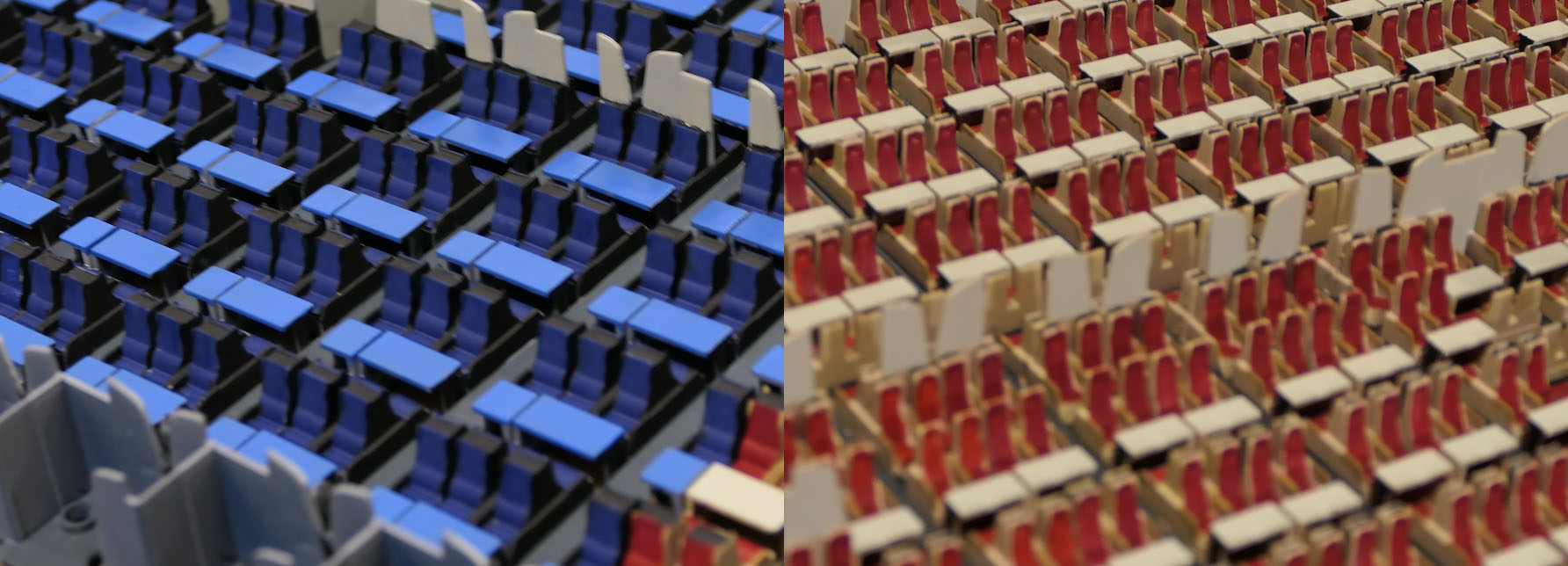
In first class, the mouldings were sprayed with grey primer, then the seats painted dark blue and black, with bright blue tables and cream bulkheads.
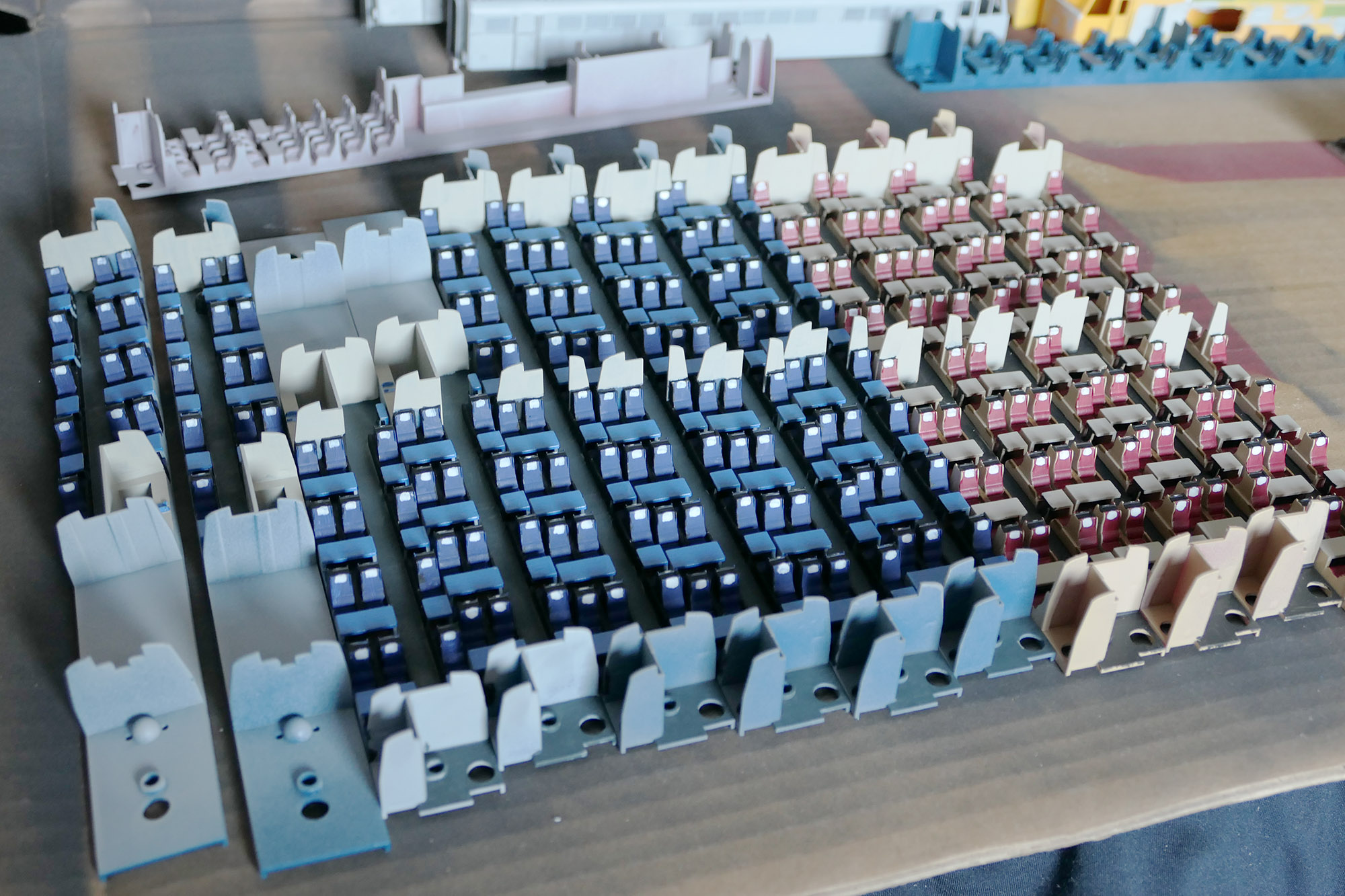
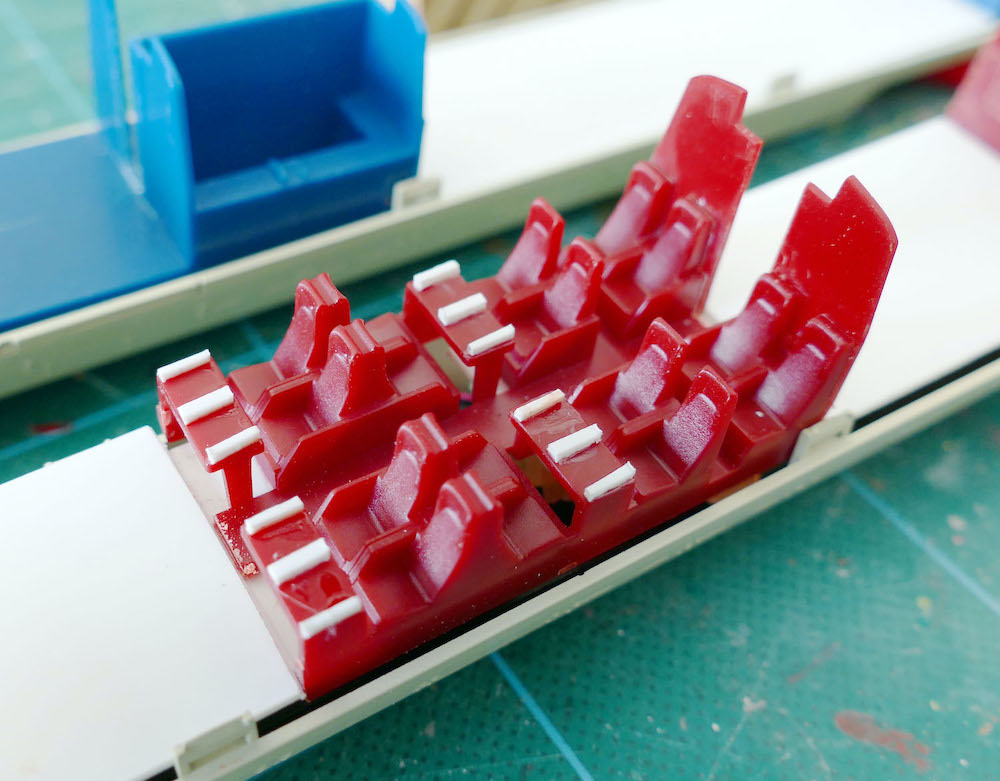
Finally for the saloons, antimacassars were added in white to the first and unclassified seating. The eagle-eyed observer will note that there are twice as many interiors here as needed for 370005 and 370006 - this was a production line also covering 370002 and 370007 (to follow)!
(Bad pun on contemporary kids' TV!)
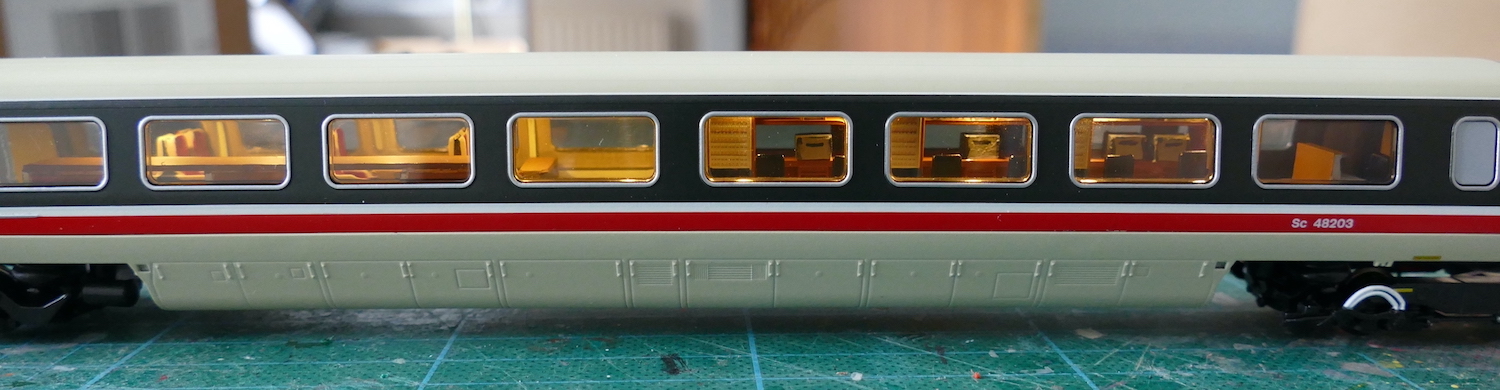
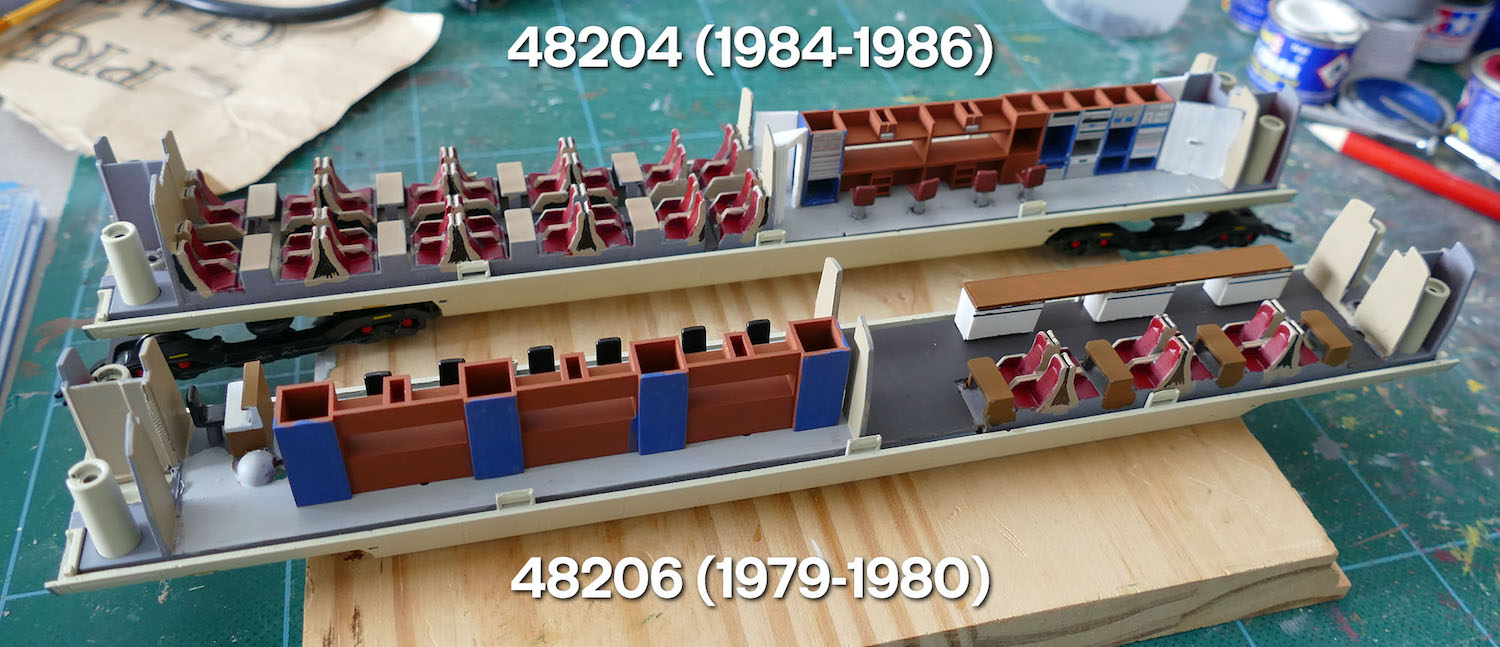
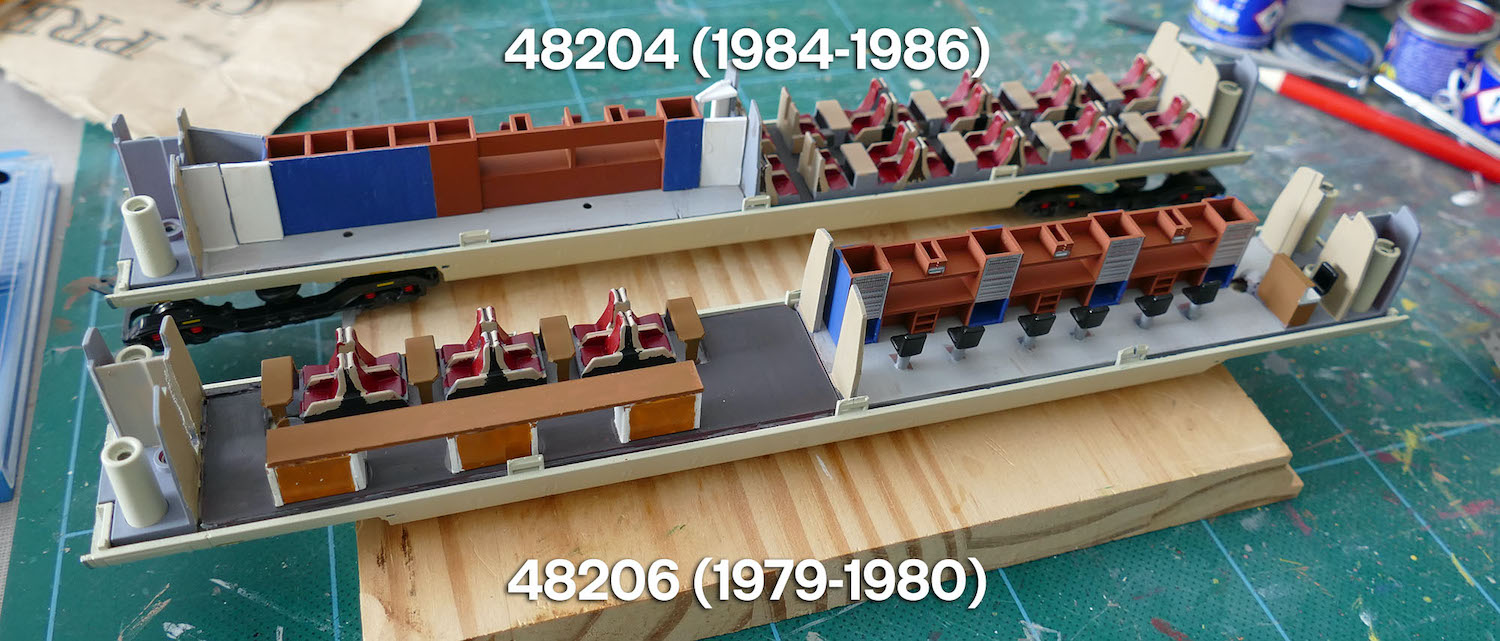
One feature of the prototypes that is often overlooked was the experimental colour variety applied to all six buffet cars. So far, five different colours have been identified, and tentatively associated with particular buffet cars! This was done with reference to the very few interior photos available, where at least the unit could be identified, thus giving a good idea of which buffet car was pictured. Even then, some have had to be cross-referenced, and some personal anecdotes found online suggest things might not be as currently assumed.

Here are the current educated-guesses:
- at the back is 48401, from 370005, in bright orange;
- next dark red 48404, originally in 370002, if notes by yours-truly, age 8, are accurate, and later reformed in 3-car 370003 (preserved at Crewe);
- then the mysterious green buffet car - I've speculated it was 48402, formed in 370004 during commissioning and before the set was paired with 370003;
- next, a bright red 48406 from 370007;
- and finally, for now, a pale brown 48403 from 370006.
A lot of these shades are similar, and with the vagaries of colour reproduction (and regular use of flash), it's hard to be confident, purely on colour in the available photos. So in addition, patterns on the wood veneer, and the alignment of the carpet wall and ceiling covering have been compared to cross-reference photos and match up vehicles.
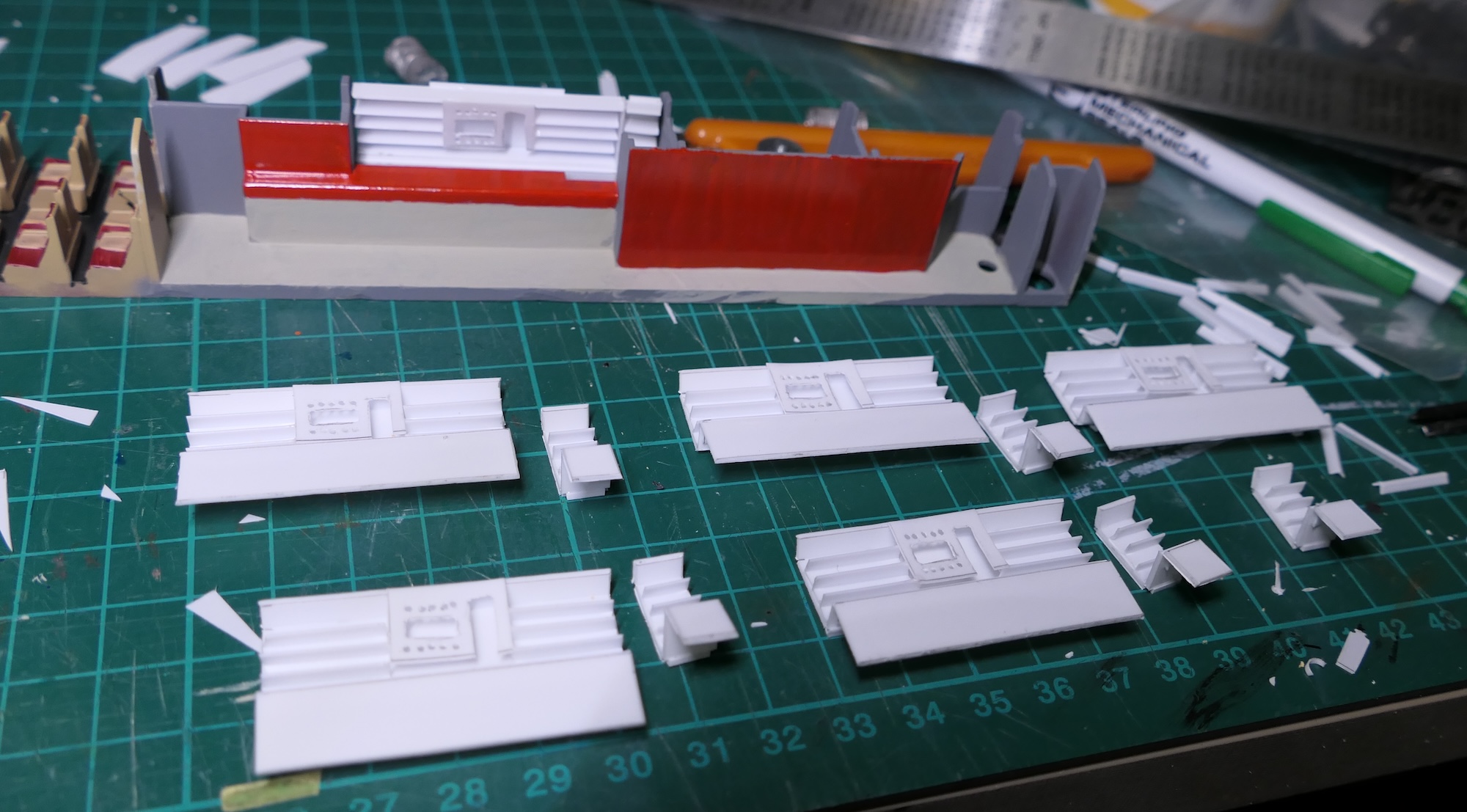
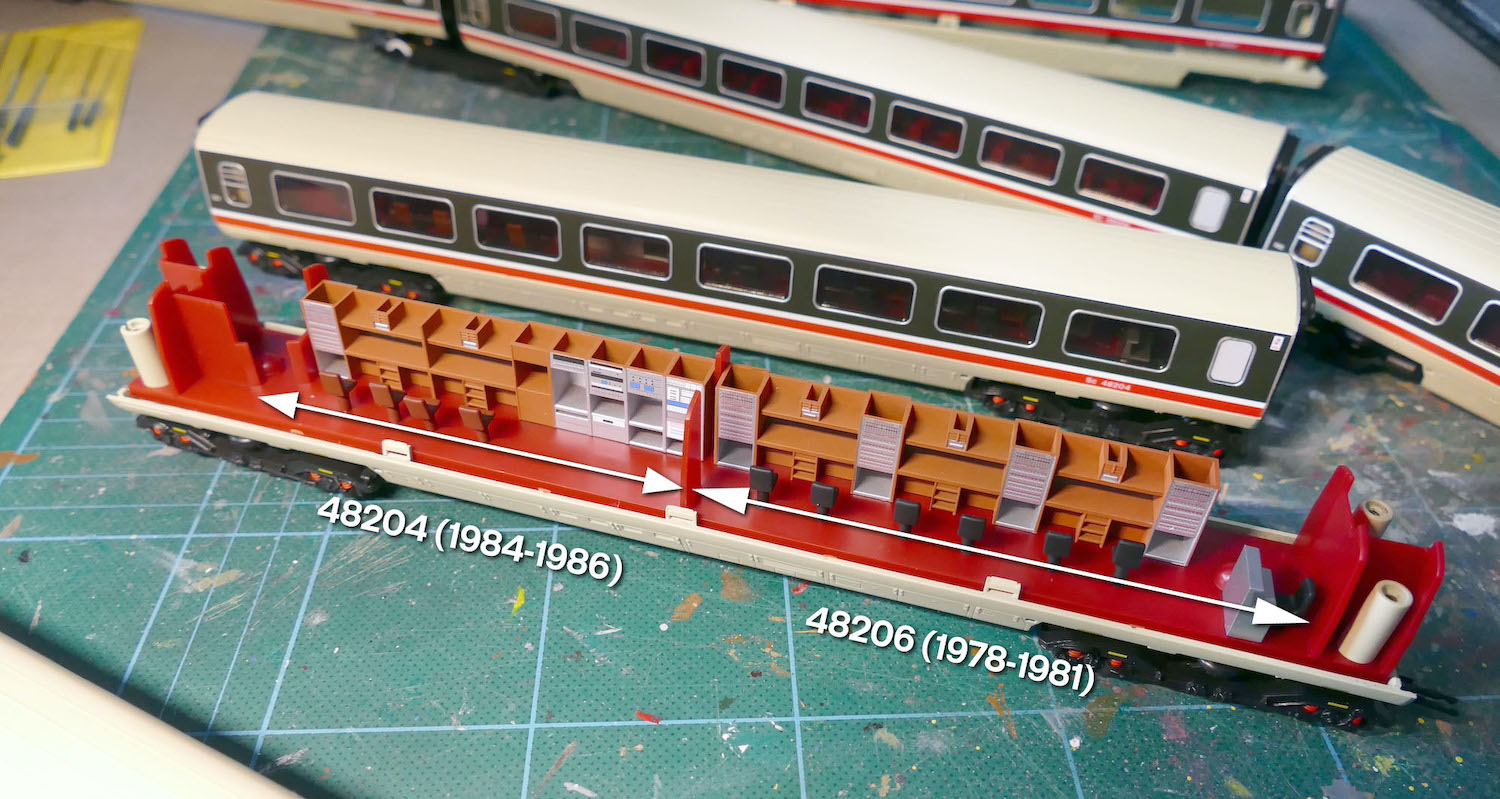
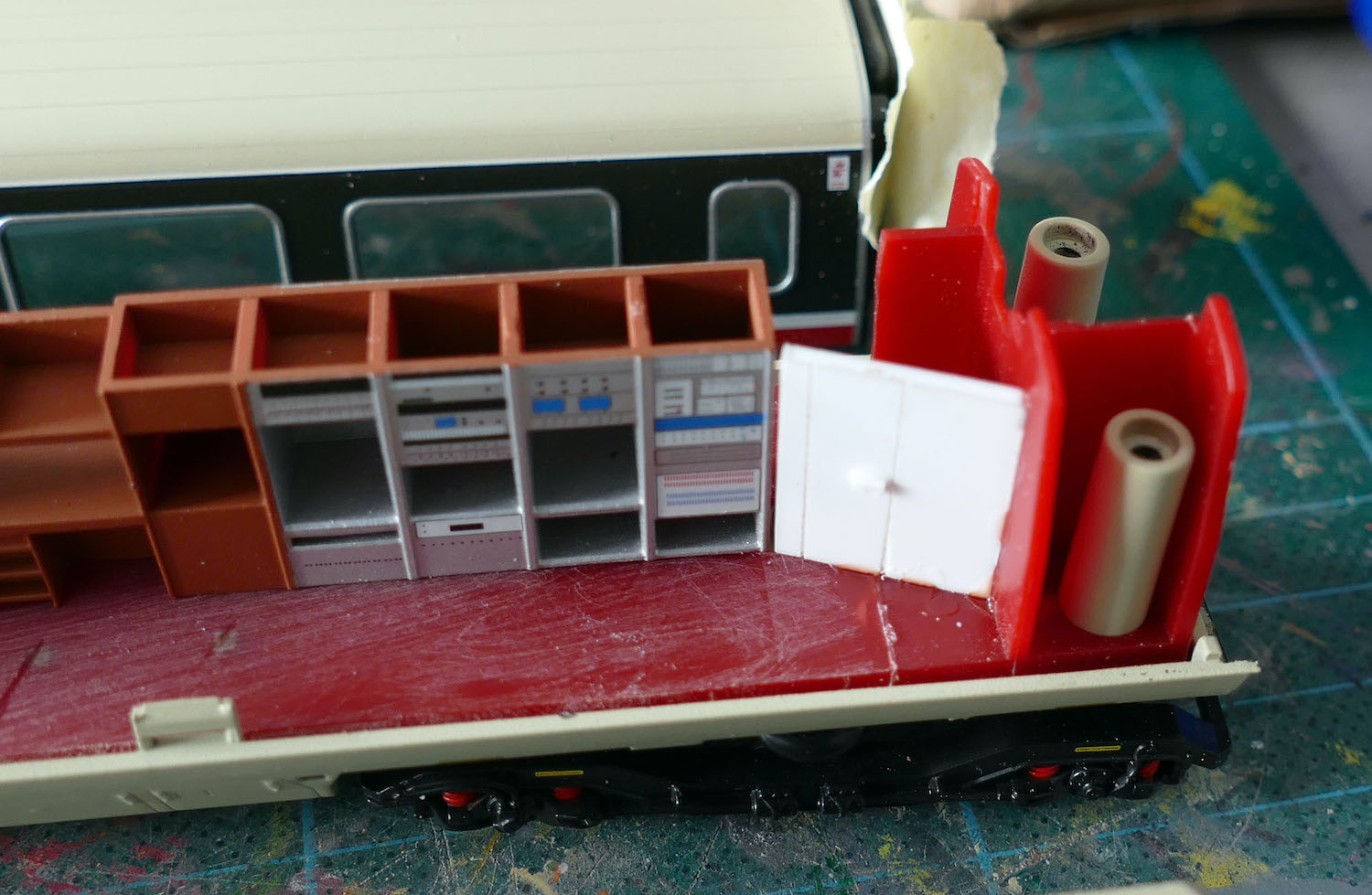
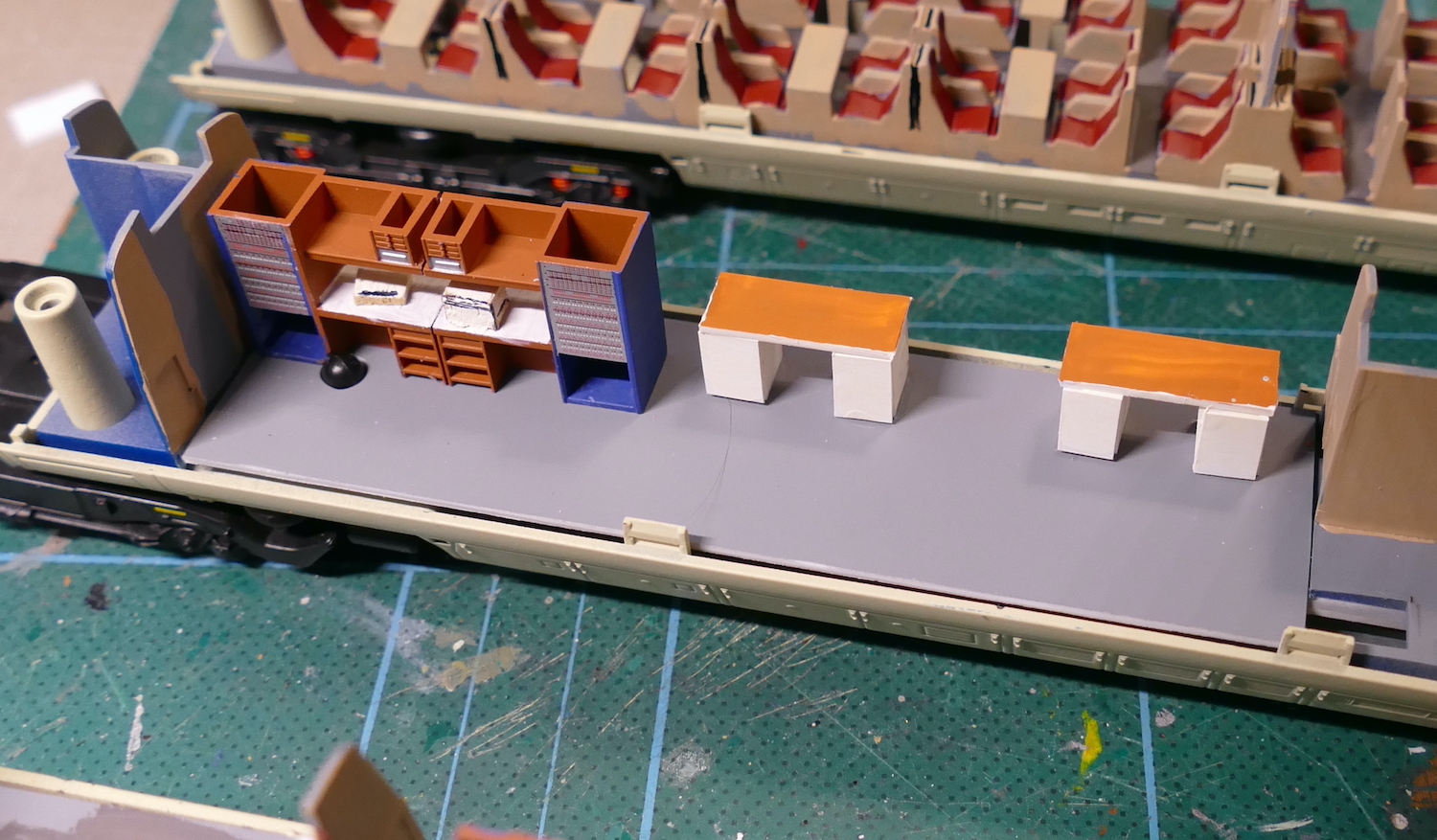
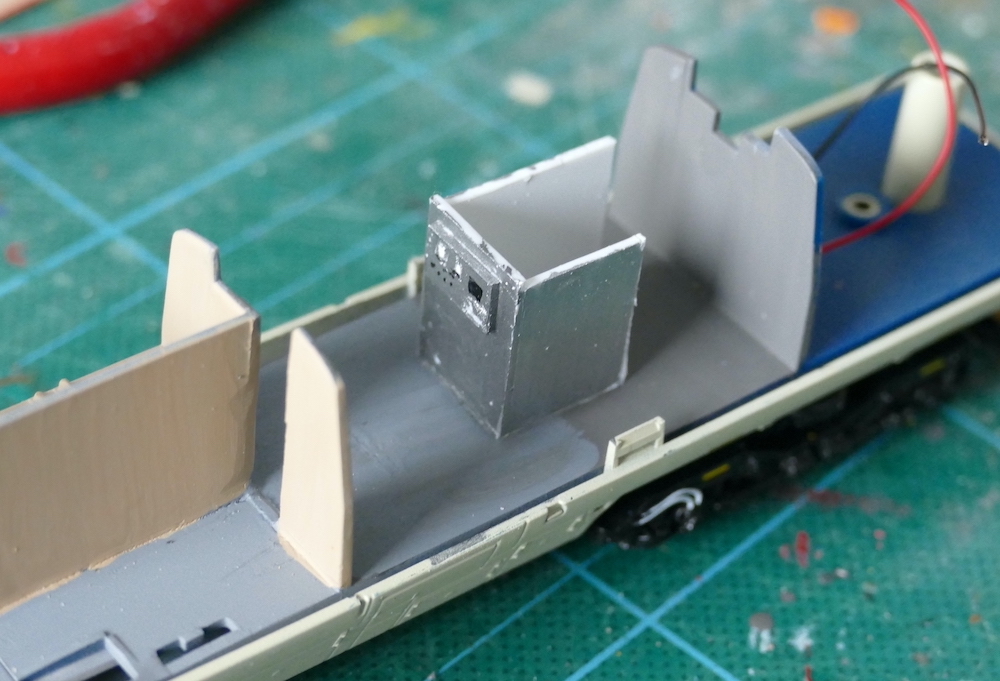
Although the buffet counter is moulded, it's not quite accurate in terms of its cut-outs and width, nevertheless, it is close enough. What's missing from the model is the display unit on the rear wall behind the counter. These would be ideal for a 3D print, but in the absense of a printer, for now some plasticard representations were constructed to represent the shelving.
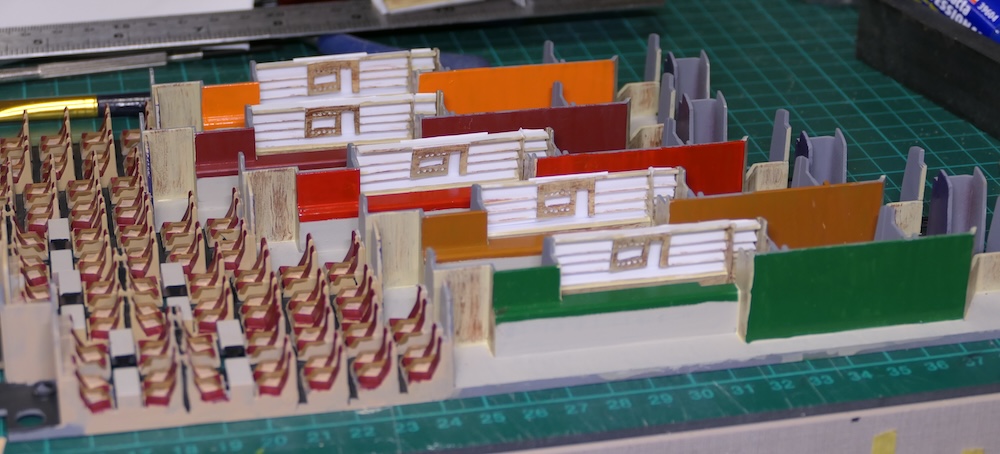
Not the best "wood effect" paint job, but they'll do for now!
49002 was, as you might expect, the second power car completed, but also the first to be outshopped in the "correct" APT livery. It was initially tested, with and without 49001, in the company of the prototype HST power cars and various test cars - usually Test Service Car 8, and Test Car 5.
Following the APT's "first run" in April 1979, which featured the named power car, 49003, between 370001 and 370002, unbranded 49001 and 49002 were substituted, and this set became the main test train for the next few months. As such, 49002 is very likely to have been one of the two power cars powering the record-breaking set that hit 162.2mph on 20th December 1979.
At some point in late 1979 or early 1980, 49002 received the BR arrow and APT logo on opposite sides, and also had the pantograph isolating switch added to the roof equipment. Which is fortunate, as that means it doesn't need to be carved off the model like 49001 earlier! In this form it appeared as part of this probably-first 14-car set, in July 1980.
A year and a half later, it had the distinction of being one of the two power cars (with 49003) to work the first public service in December 1981. From then until 1983 it was in general use, but around that time became one of the two power cars (with 49005) mostly dedicated to the Crewe-based test trains. In summer 1983 it was used for very high-speed pantograph and overhead line testing, exceeding 150 mph on a number of occasions.
This continued to be the case until the end of operations in 1986, and consequently 49002 found itself as part of the last operational unit, thus surviving into preservation. It is currently at Crewe Heritage Centre and is still formed in the middle of the two surviving trailer rakes.
The fourth power car first appears on test sometime around September 1978, in the currently available photographic record, again with TSC8, TC5 and a prototype HST; in early 1979 it was still on test, but by then was paired with 49003. Its first appearance (so far found) in an APT rake is indeed this July 1979 full-length formation. Several journey logs made on BR-staff test runs with this 12+2 show that this combo persisted through to at least the end of November 1980.
But that is where the records of 49004 in operation in APT sets currently end, a mere five months after they started! While a 14-car set continued on test into 1981 (with 370007 replacing 370005 on at least some occasions), at present there is no information about which power cars featured after the end of 1980.
By April 1982, however, 49004 was in Derby works, bogie-less, and up on jacks, missing some roof panels and its pantograph, as if undergoing an overhaul. However it was still in the exact same spot in June 1983. By the start of 1984 it was once again on bogies in the works, though apparently incomplete ... and by the middle of the year had been parked outside, missing some roof equipment. A close inspection of the bogies reveal them to be on the "wrong ends" - the one with the pantograph stabilisation beam attachment was at the non-pantograph end, and vice versa. In fact, I have a suspicion that the bogies were from the tilt-test vehicle "Trestrol", and not production power bogies at all. In any case, the 49004 remained in the same spot for around three years, with paint gradually peeling, until at least April 1986. The most recent image of 49004 is of a very stripped bodyshell, by that point on accommodation bogies, on the scrap lines in October 1986.
So it seems that 49004, like its number-sake trailer-rake 370004, became an early source of spares, and may have only run in APT formations for around a year, if that. It certainly never received a Brecknell-Willis High Speed pantograph (sorry Hornby - again), and almost certainly never ran again after the end of 1981 / early 1982.

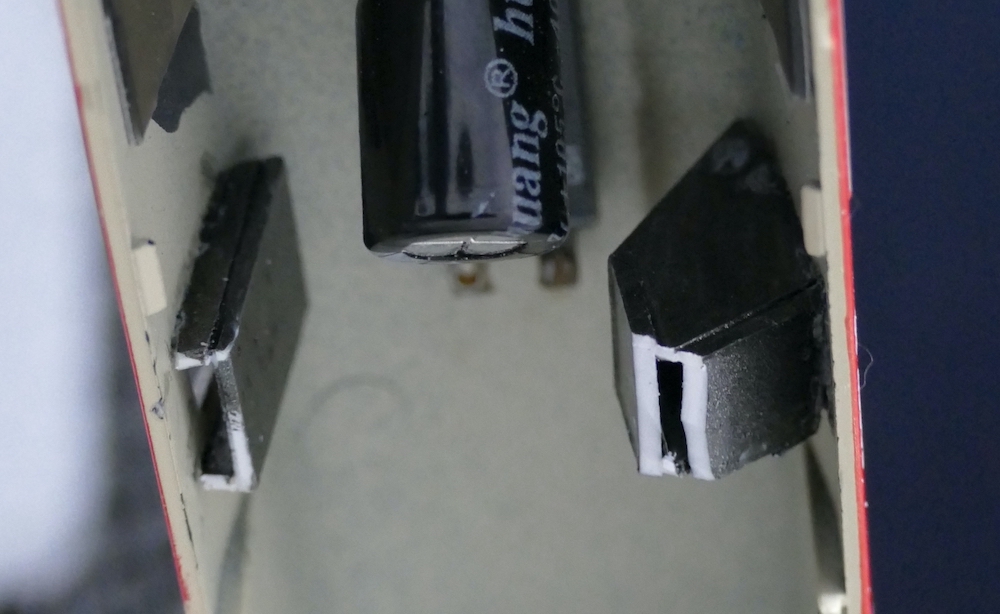
With the pantographs removed and body parts separated, the first modification was to paint the insides of the four corner shafts black.
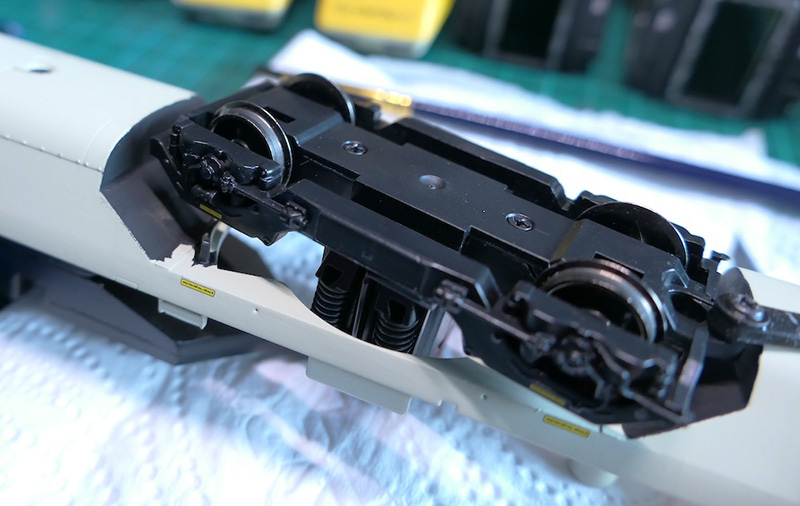
The bogie openings were also painted black, as per the prototype - a subtle change that makes quite a difference when put on the track.
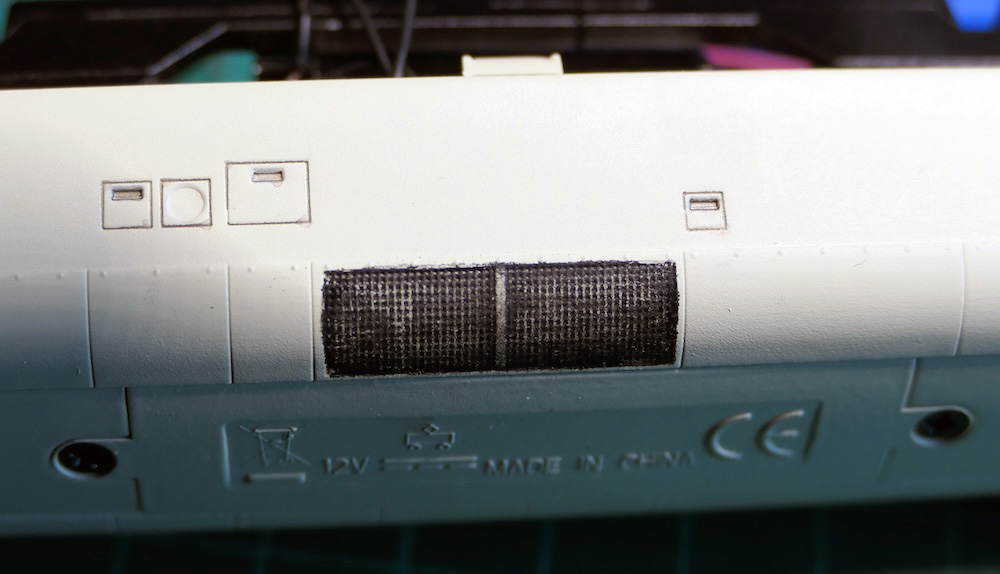
While the black paint was out the lower grilles were darkened, and using a bit of panel lining, the hatches were highlighted.
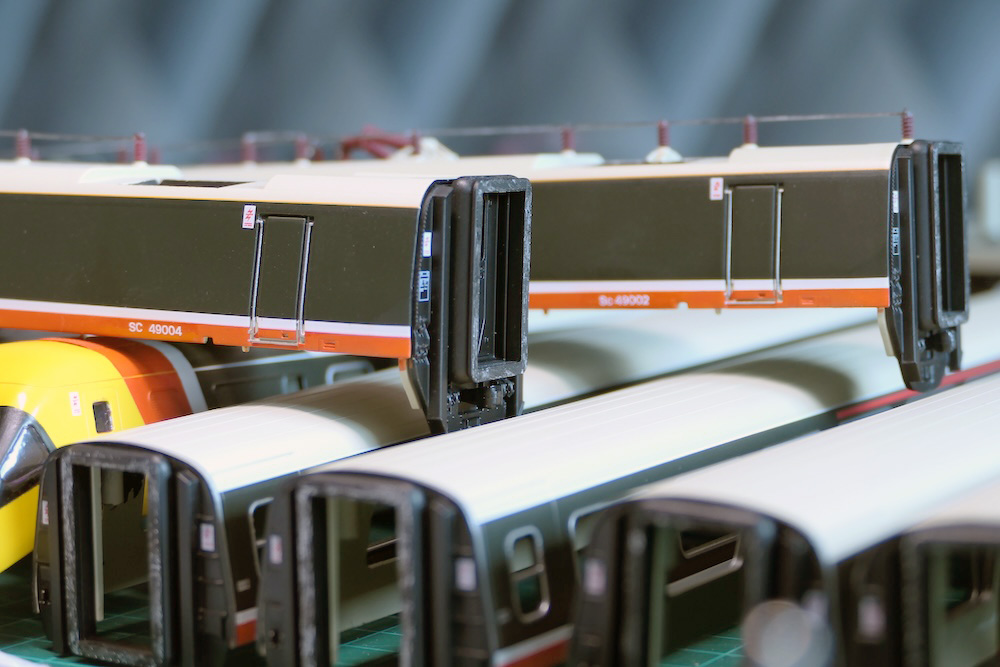
Numbers applied! Following the prototype at this time, there was some variation on the spelling of "Sc"! 49004 had all caps on one side, and regular upper-lower on the other, while 49002 was double-regular. The incidence of "SC" vs "Sc" on the power cars varied over time - definitely a case of "choose your date and look for photos".
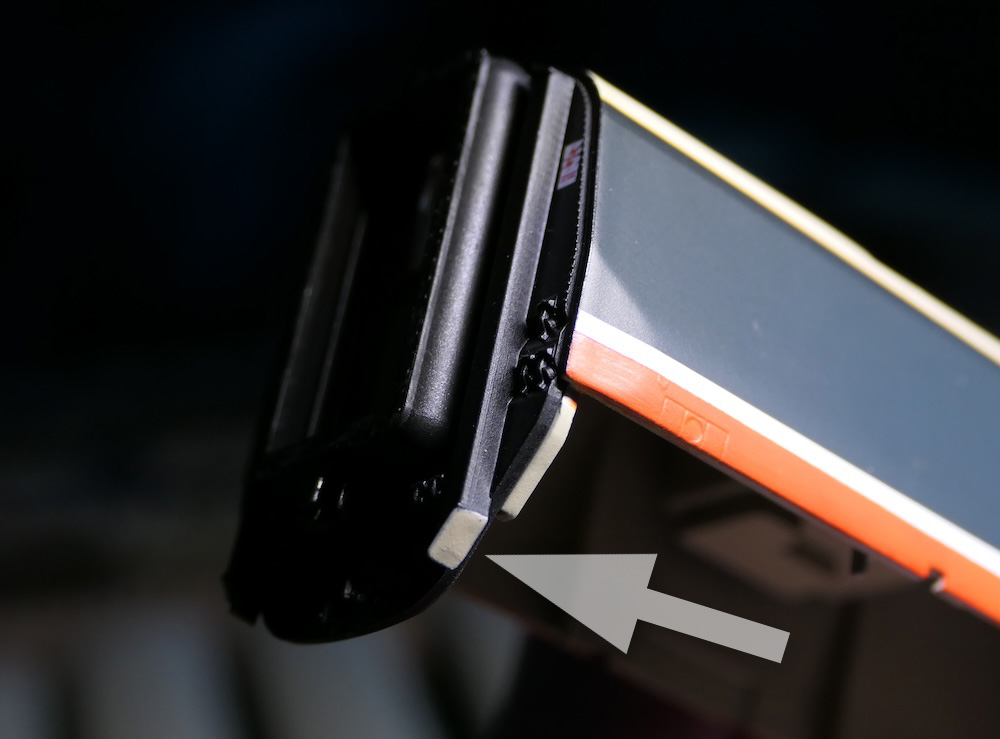
A tiny detail for obsessives - the lower edge of the trusses that run down the power car ends should be finished in the lower bodyside colour; I've touched them in using Executive Light Grey, which is a near match. I also painted in some of the gauges and fire handles with spots of white or grey, and touched in some warning yellow to the square recesses on each side that straddle the upper and lower mouldings (seen unpainted on the right of the photo above).
Up on the roof
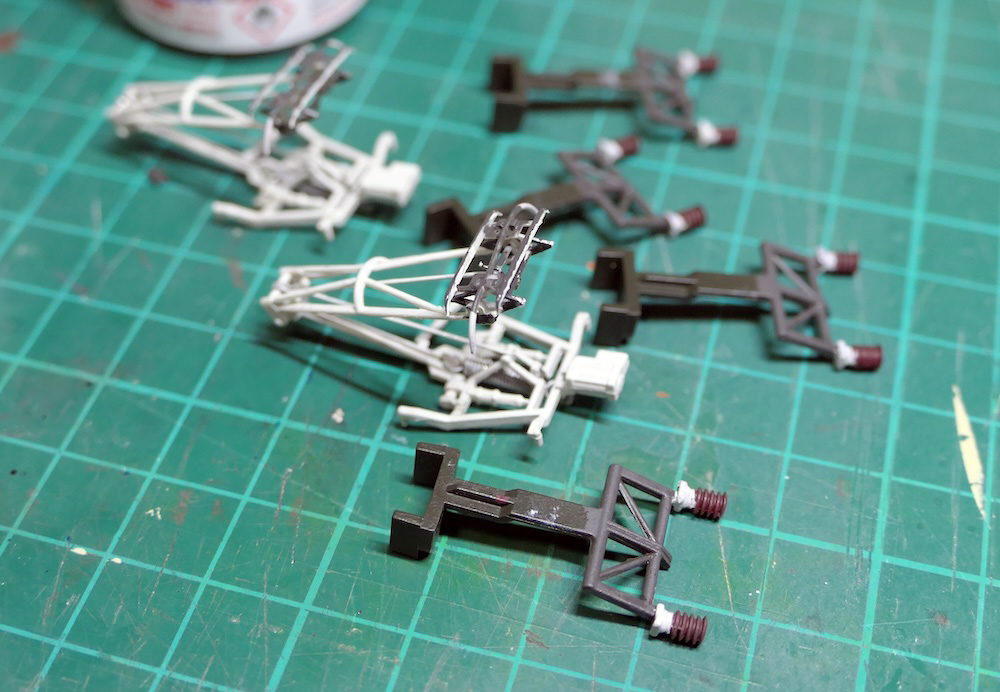
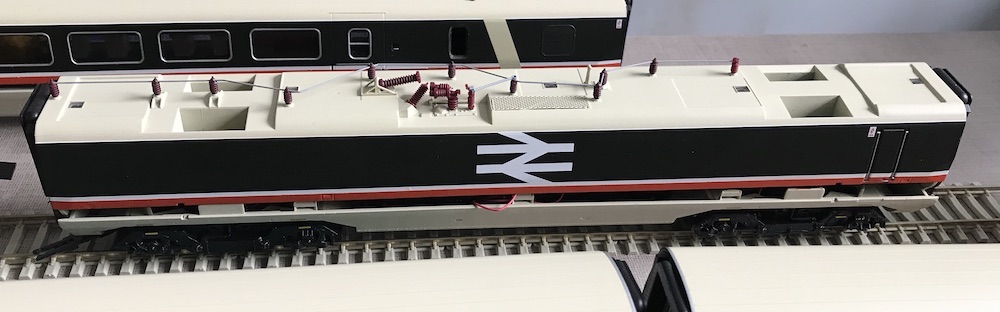
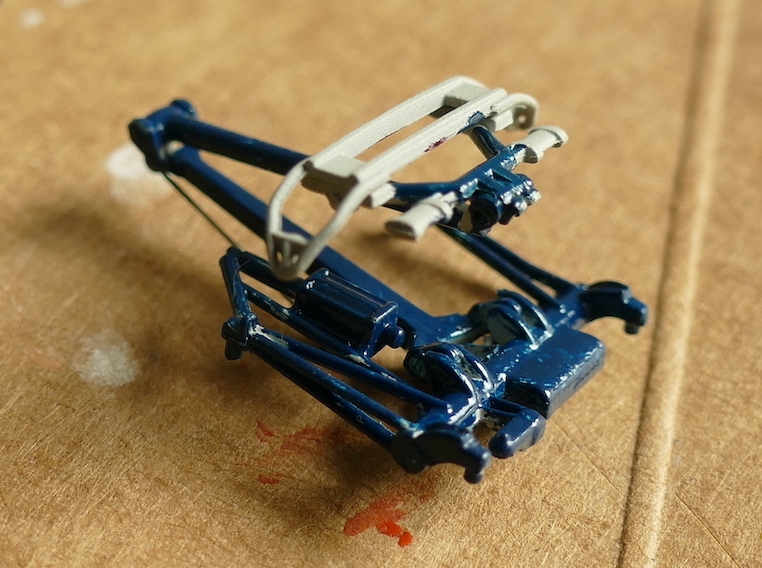
As supplied, Hornby's "black mask" power cars come with Brecknell-Willis HS pantographs, but (not counting the 1980 B-W pantograph test train) these did not appear until 1982, after which they were progressively fitted to the operational fleet. So for 1980 these are replaced with the original two-stage Stone-Faiveley pantographs.
The frames have been over-painted in Silver Grey, with some darker details around the pantograph head and upper suspension unit. The stabilisation frames have also been touched in with "dark iron", Rail Grey, and "hull red" for the insulators.
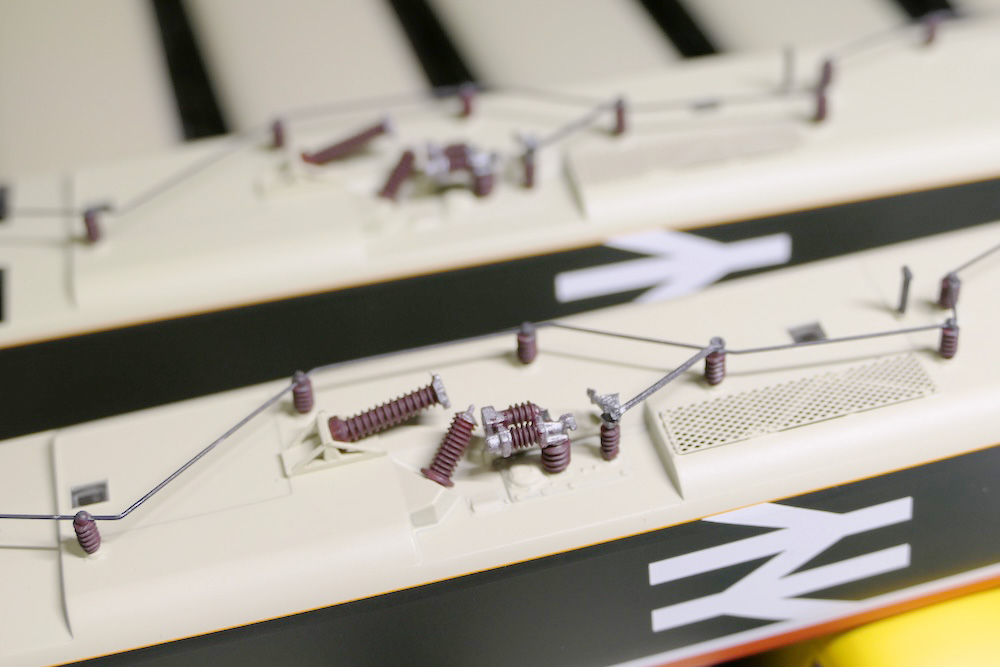
Similar paint touch-ups for the roof-mounted equipment. As supplied, the main circuit breaker switch arm is moulded in the open position - which means this power car ain't goin' anywhere. Although not yet modified, these will be snipped off at some future point, and replaced with a bit of plastic strip such that they are closed, and thus providing power.
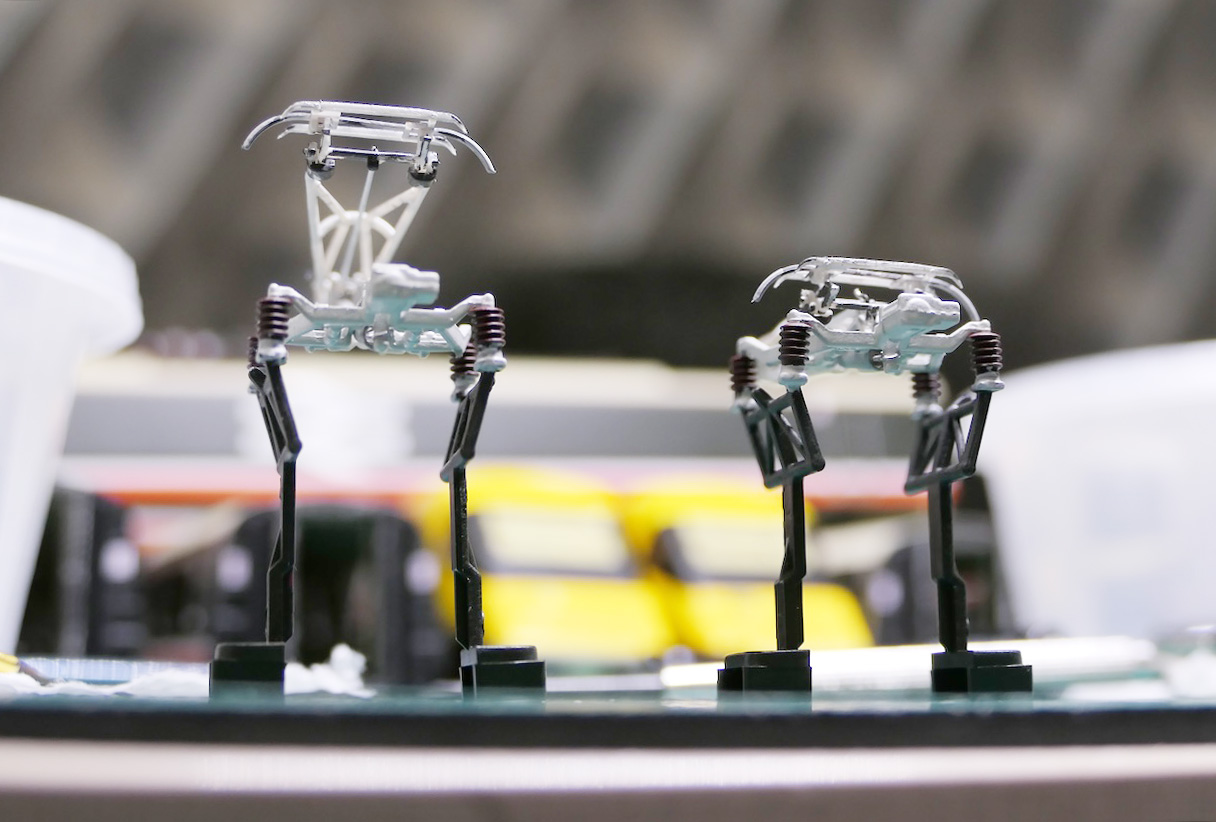
The Contact-Wire Strikes Back? Return of the Faiv'ley? I'll get me coat.
The Trailers - removing the windows
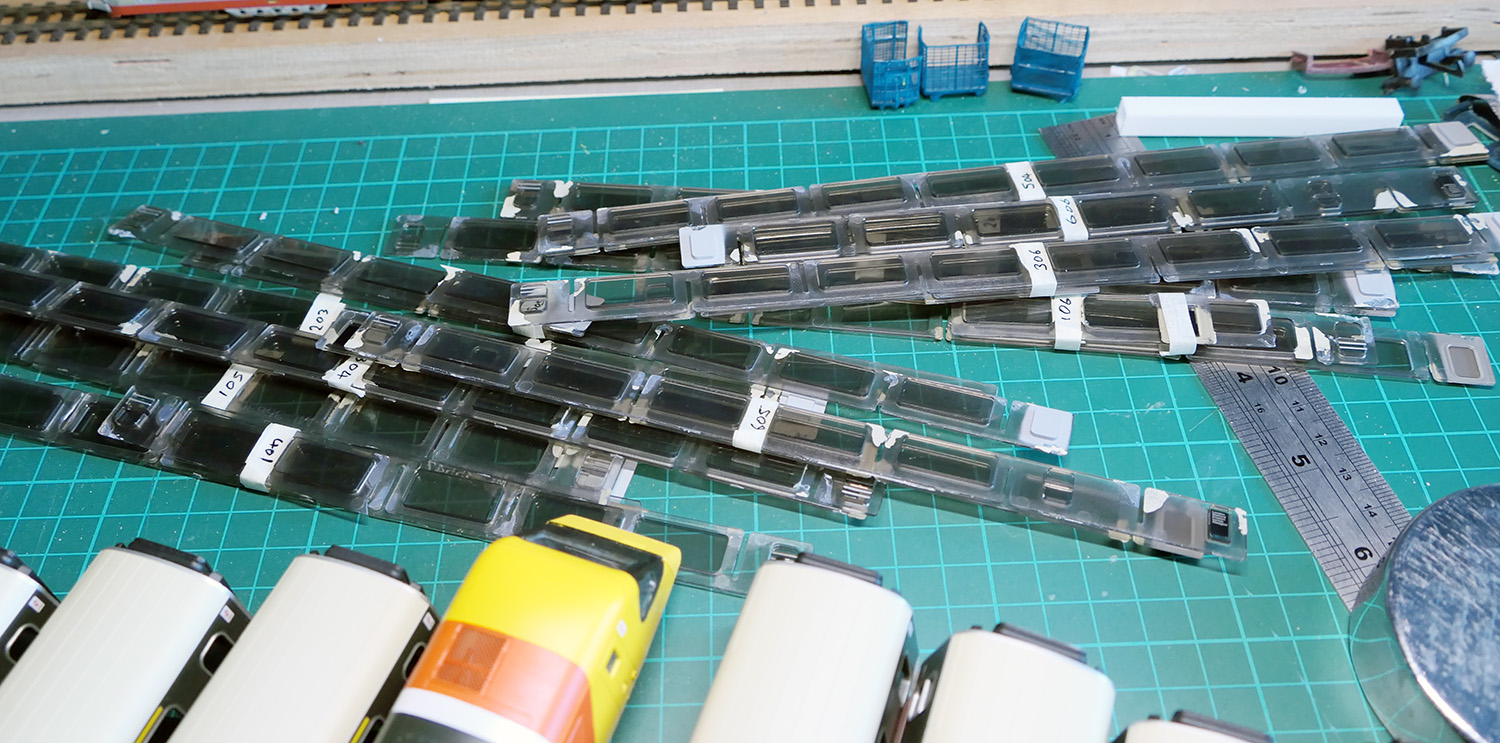
Ahead of applying a coat of varnish, most of the glazing was removed by applying a gentle pressure from the outside, while slipping a small flat screwdriver blade under from the inside. Working gently along the strip, prising the glued areas apart minimises the number of snapped strips.

This leaves just the cab windows, which were masked rather than removed, after trouble refitting them on the previous set.
The Invisible Stripe
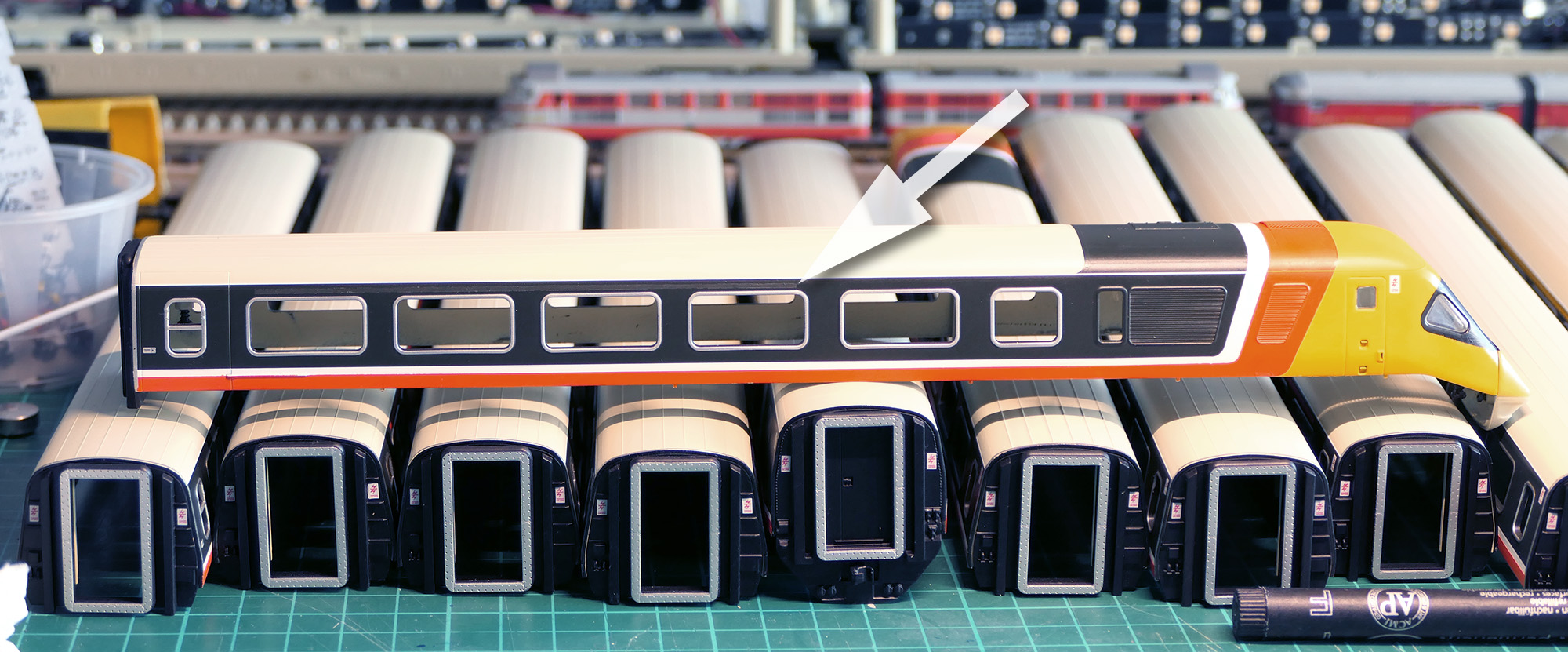
Before entering traffic, and possibly even before being commissioned or tested, 48105 was the recipient of a livery experiment or two, as mentioned above. One of these was the application of a red 'catering' stripe above four of its saloon windows, presumably to try out the style subsequently adopted for the red and yellow stripes on the relevant trailer cars. Naturally, before 48105 entered traffic, the stripe was gone - it wasn't a buffet car after all!
A close inspection of clear photos of 48105 in service shows that the stripe was painted out - in fact, by 1987, just prior to scrapping, some of the overpainted dark grey had flaked off, revealing the buffet red stripe once again.
So, for those with obsessive tendencies...
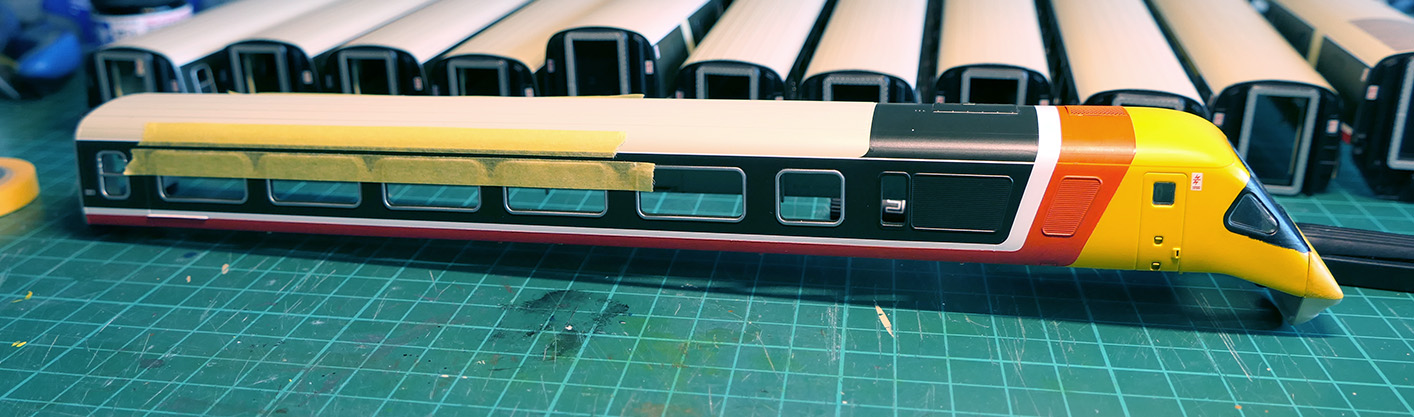
A simple mask along the four windows on both sides, and a quick brush of Executive Dark Grey - similar enough not to notice at first glance, but just different enough to pick out if you know what you're looking for.
Finishing touches

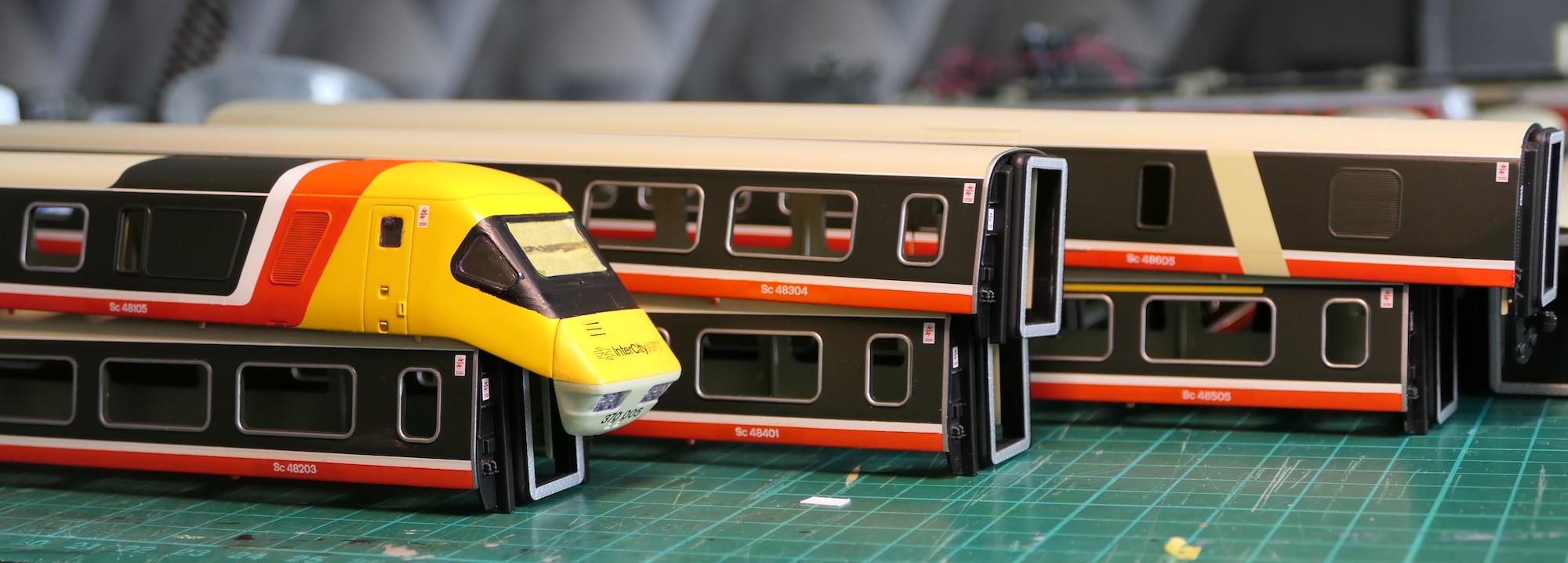
As with the power cars, all trailer cars received their numbers. Both 005 and 006 had one vehicle in their intermediate trailers with matching last digits - only three instances of this occurred across the fleet:
- TS 48202 in 370002
- TF 48505 in 370005
- TU 48306 in 370006
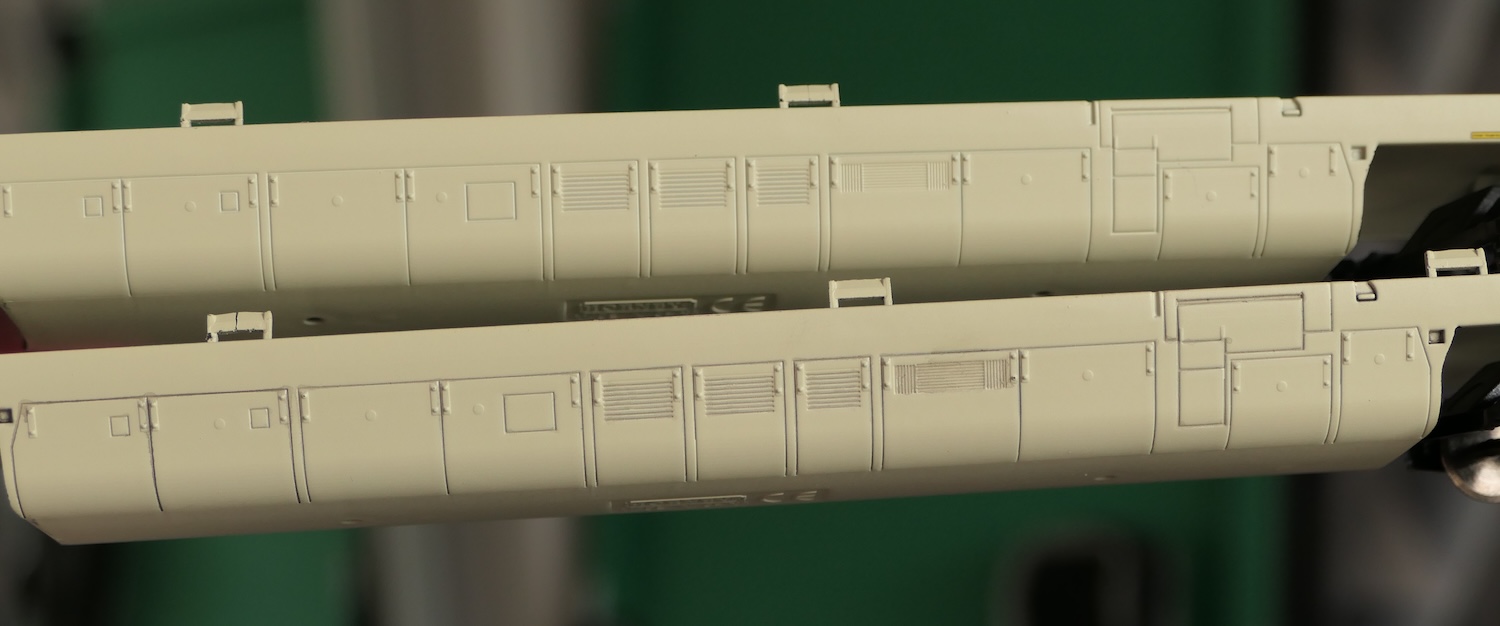
Although these units were essentially brand new, and did not need much in the way of weathering, the underframe hatches were picked out with a bit of panel lining, just to add a touch of definition (before and after, above). This worked on most vehicles, but a couple of the types had shallower mould lines on one side than the other, which left the lining struggling to 'creep' along all the cracks.
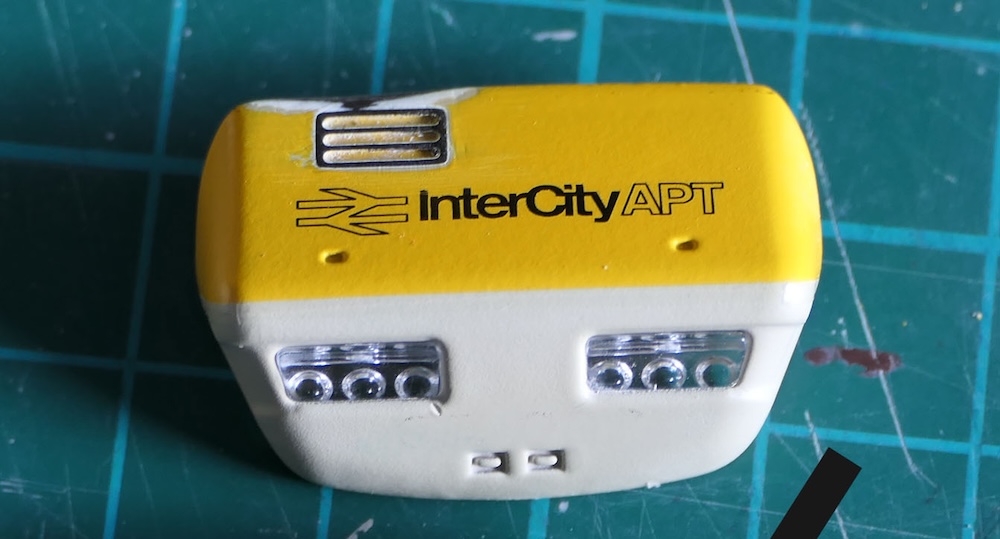
Having repainted the noses, new APT logo decals were required. Initially some commercially available waterslide transfers were applied, but these were slightly compressed vertically, and didn't quite look right.
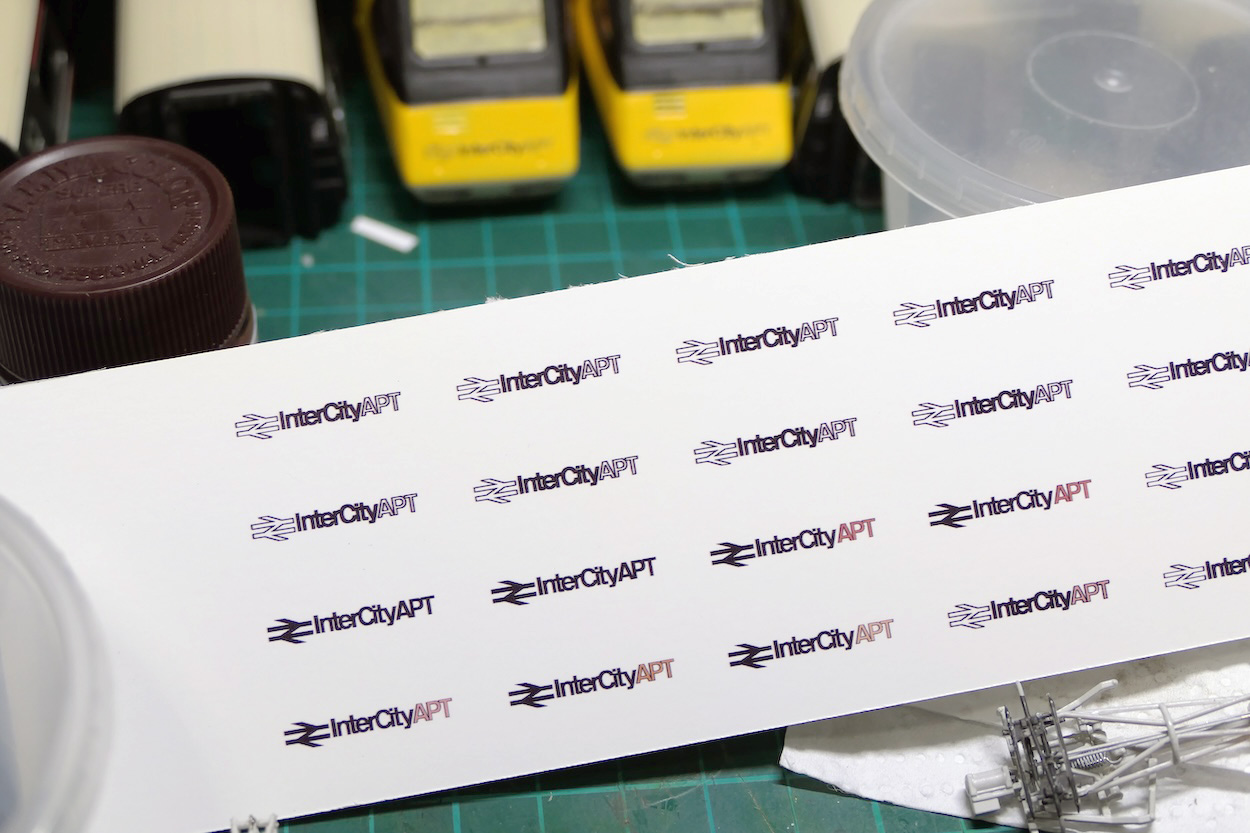
Instead some home-made waterslide decals were made, albeit not as subtle as the commercial versions in terms of carrier film!
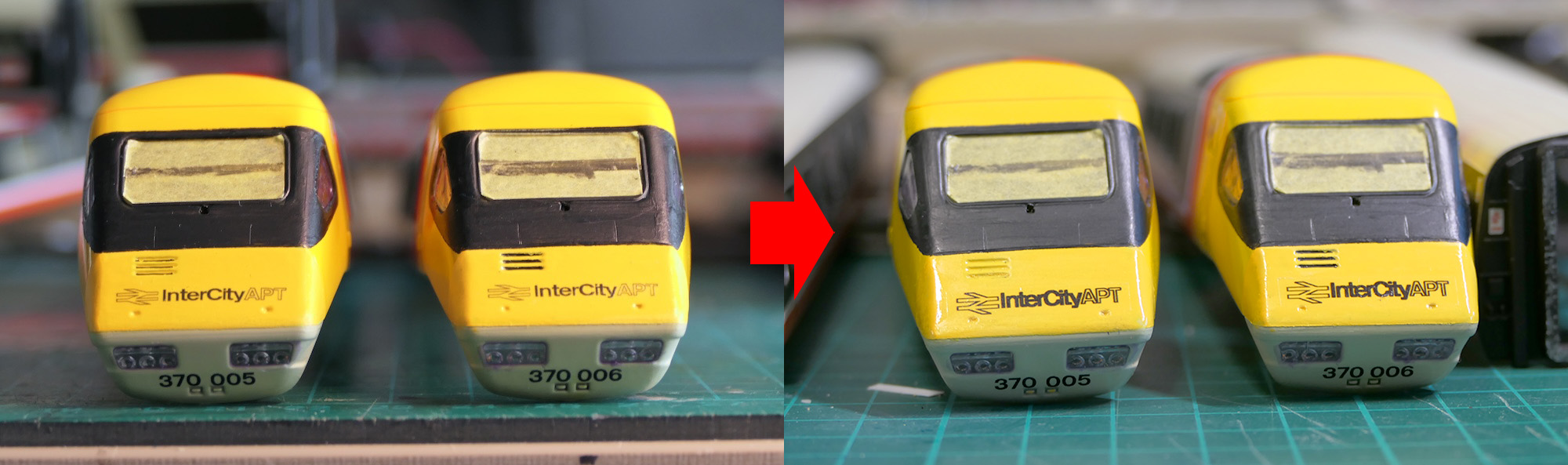
The result is a little bolder-looking, but the proportions seem to be more in keeping. At this time 370006 had the standard logo, but in later life this was replaced with what appears to have been a "home made" APT logo, crafted from a black BR logo and standard black Rail Alphabet letters, overlapping slightly - and now also created as a decal (not otherwise available)!
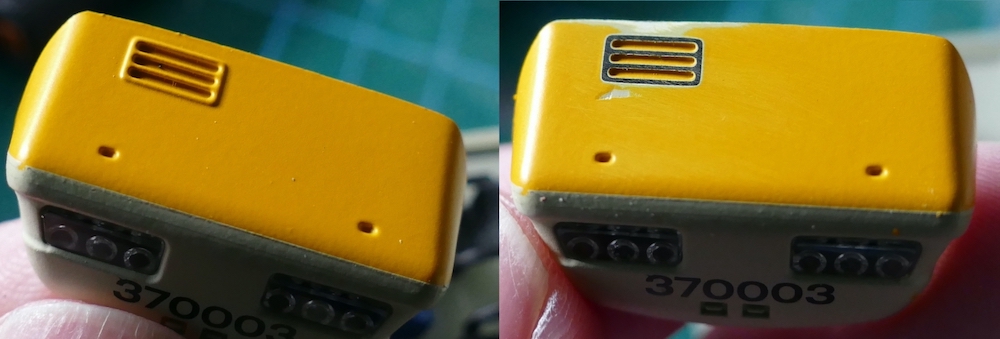
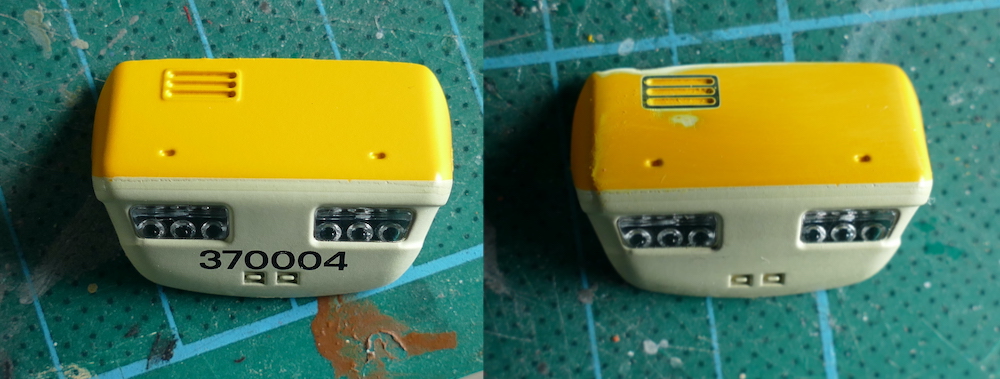
Also visible above (right hand image) are the slats for the horn grilles. On 370005 these are unpainted, while on 370006 they have been blackened with a very fine-tipped brush. The reason for this difference is that 370005, along with 370007, had their horn grille moulds mounted the opposite way up to the remainder of the fleet. On 370006 the slats are horizontal, and look directly into the nose when viewed from the front - you can see the horns behind them. However the flipped slats point downwards, and from the front you're looking at what should be the 'bottom' of the slats - yellow-painted fibreglass. This gave 005 and 007 a different appearance from the front in original condition, anf after some experimentation, the best way to depict this in model form, short of somehow cutting the slats through properly, was to paint the "regular" slats, and not paint the flipped ones. Of course, it now looks like I forgot to do 005.
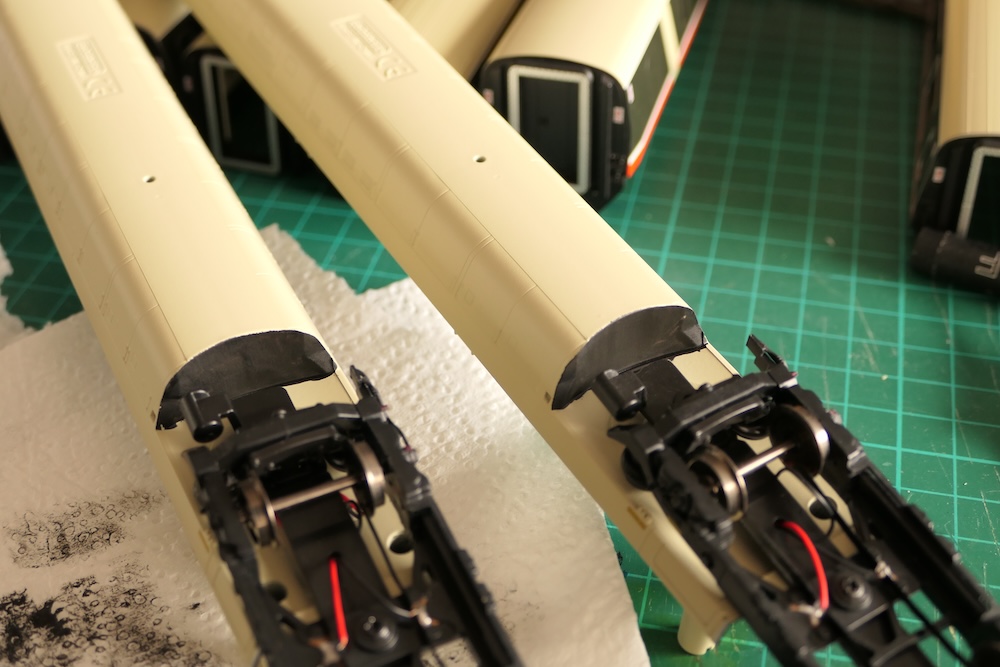
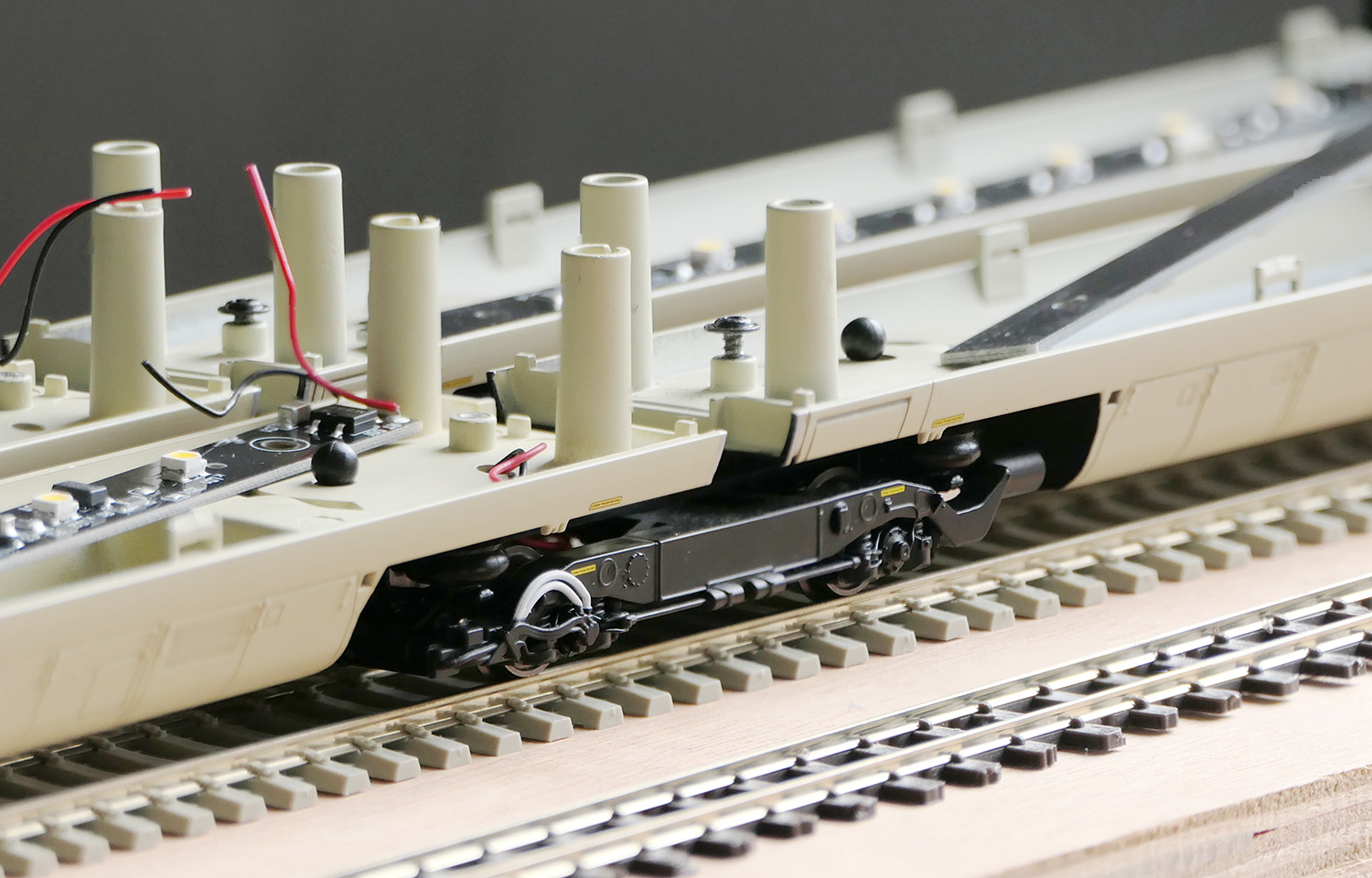
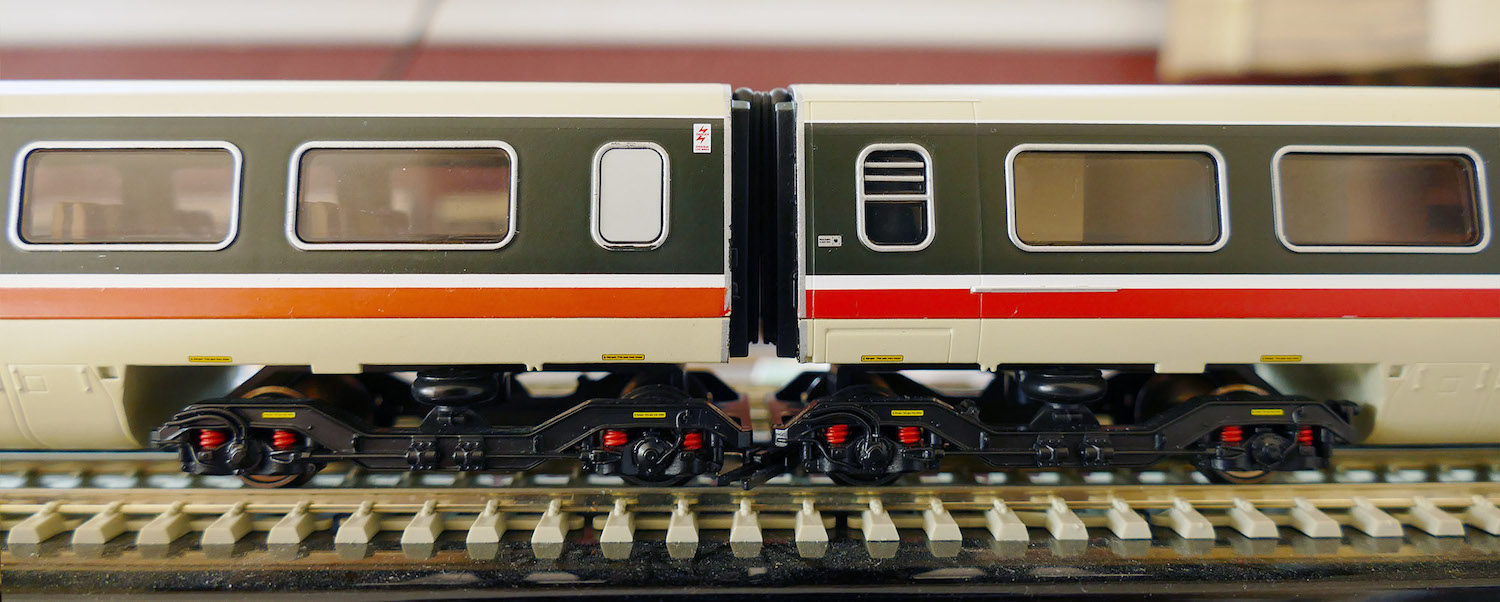
As with the power cars, the insides of the bogie insets were painted black, and with that it was about time to reassemble everything.
Reassembly
Photos of this pair in July 1980 show the units definitely have a fairly glossy shine to them, so my aim was to match that, without turning them into gaudy shelf ornaments.
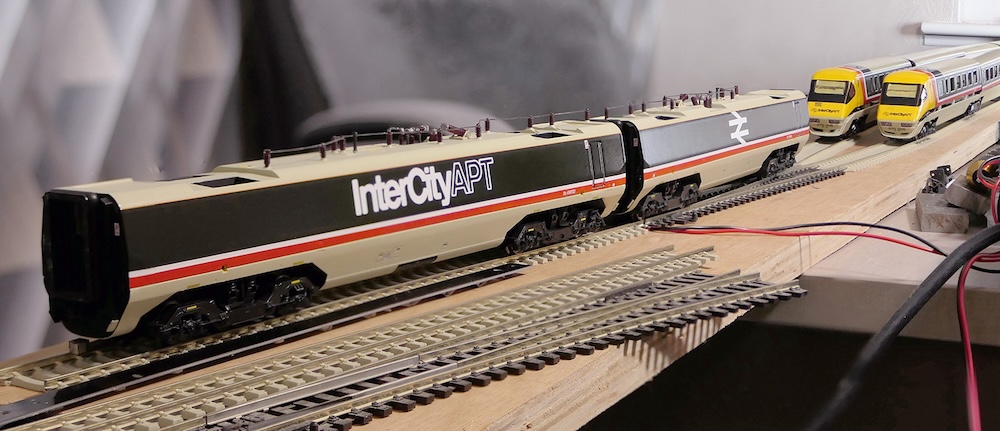
Several light coats of acrylic gloss were applied until a suitable shine was achieved, without ending up with a mirror reflection.
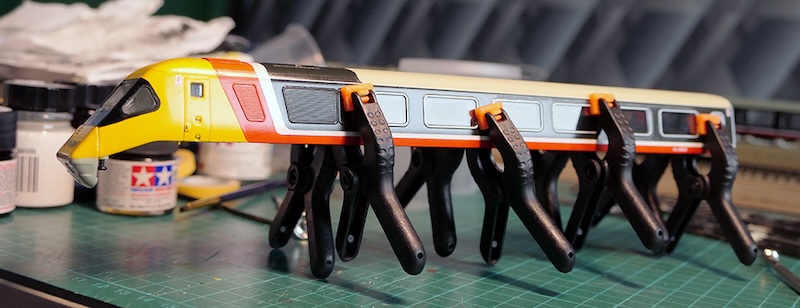
Once dry, the glazing strips were put back. When the glazing is removed, the existing glue usually pulls off a bit of paint from the insides - putting the same strips back in the same place means that any glue/paint remnants on the strip go back into the "holes" they left in the paintwork. This in turn means there's more likelihood of achieving a good fit, keeping the glazing fairly flush.
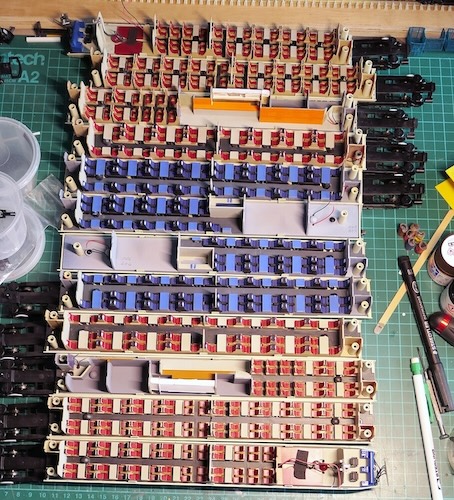
With the glazing installed, the respective interior mouldings were put back into the lower bodyshells, with wiring pushed through for the lighting. This was snipped during disassembly, and at present isn't going to be reconnected. A future project will see this reinstated.

Weathering
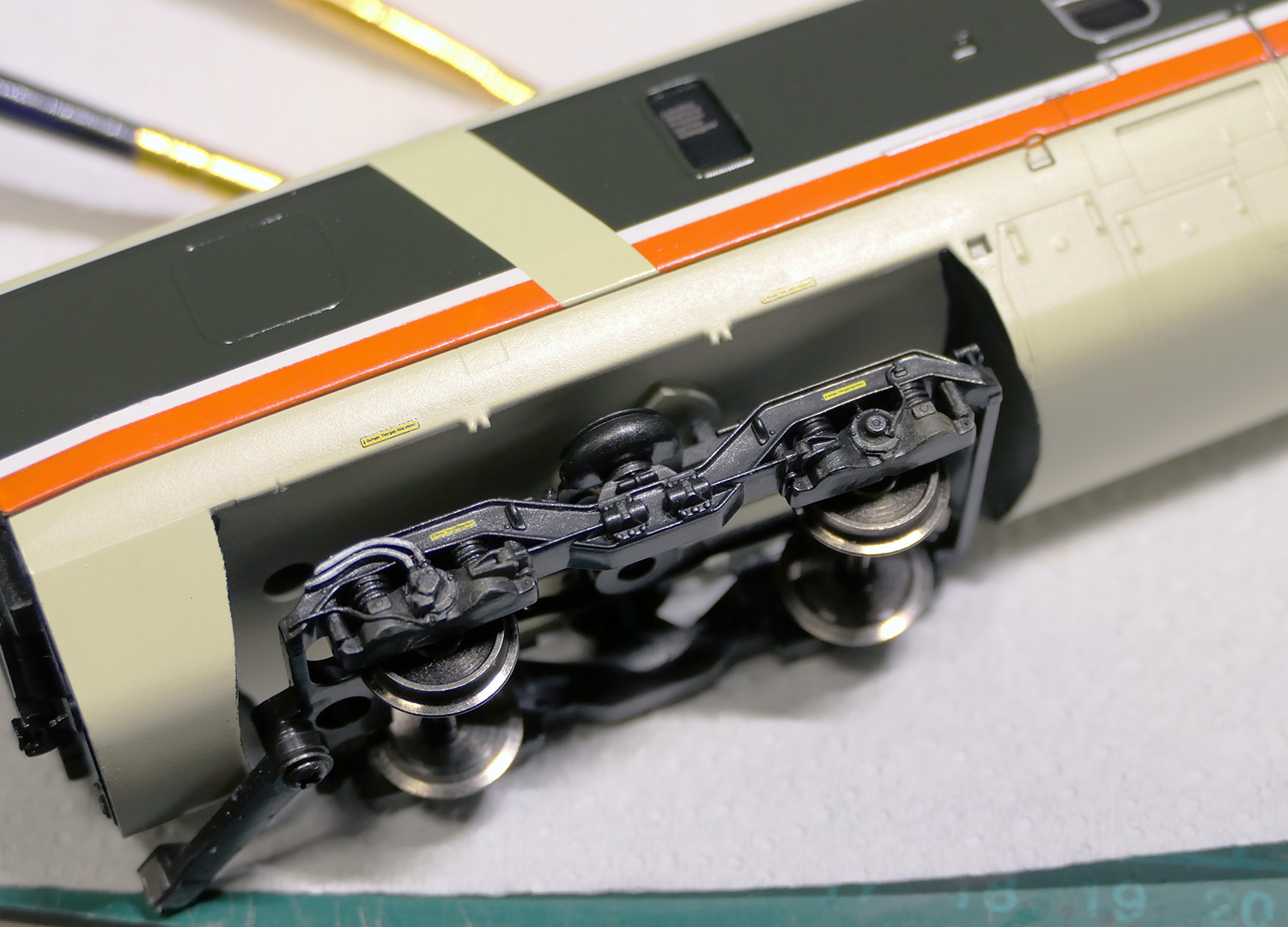
Possibly the lightest weathering ever! Using photos of the original as a reference, all the bogies were dry-brushed with a very light dusting of Gun Metal to give a slightly metallic, solid-looking shine, followed by the tiniest amount of Brake Dust on the bottoms of the primary suspension on each wheel. Matt black was then added to the air suspension bags, as they're not very metallic in real life.
Frame Dirt was used to apply some very subtle streaks to the turn-unders at the base of both power cars, again using photos of the original as a reference.
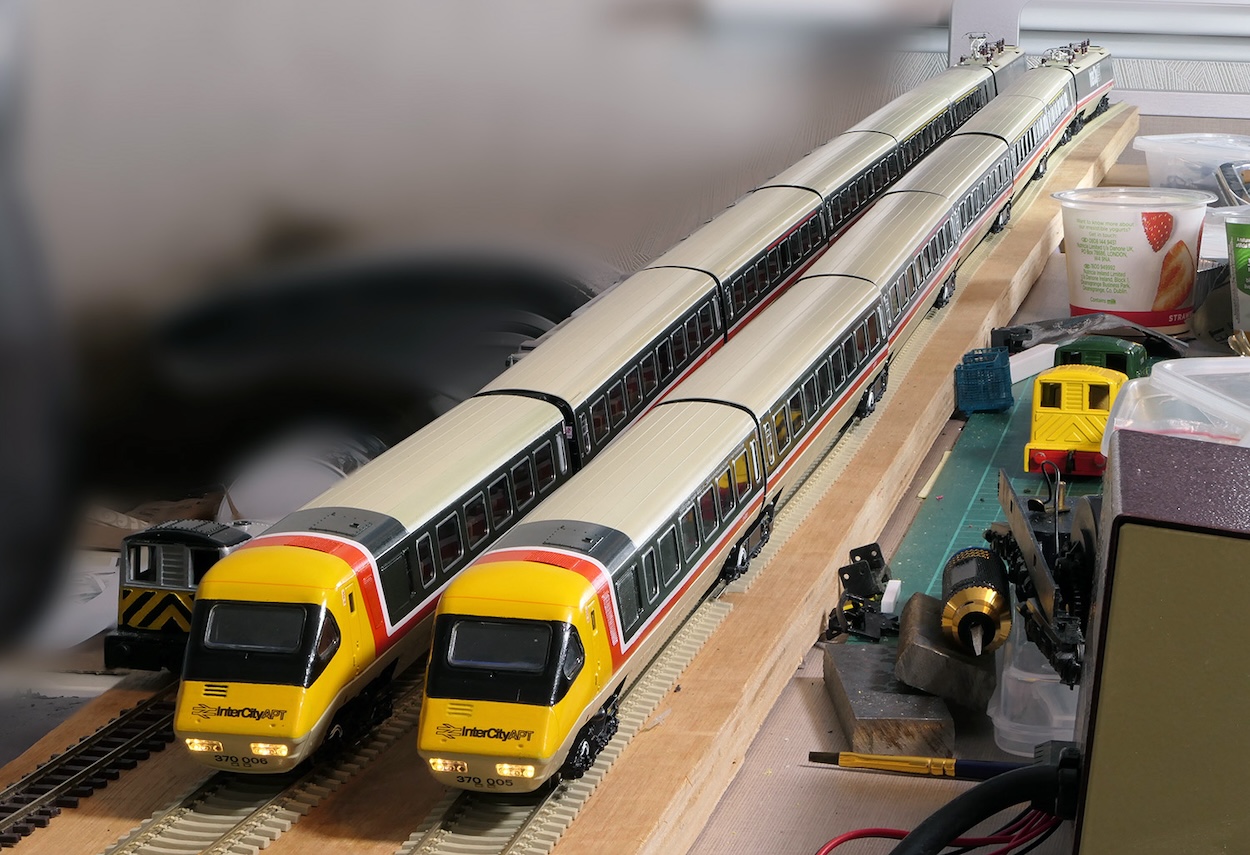
The final task of reassembly was to clip the upper and lower halves of each vehicle back together.

And after that, time to get some track out!
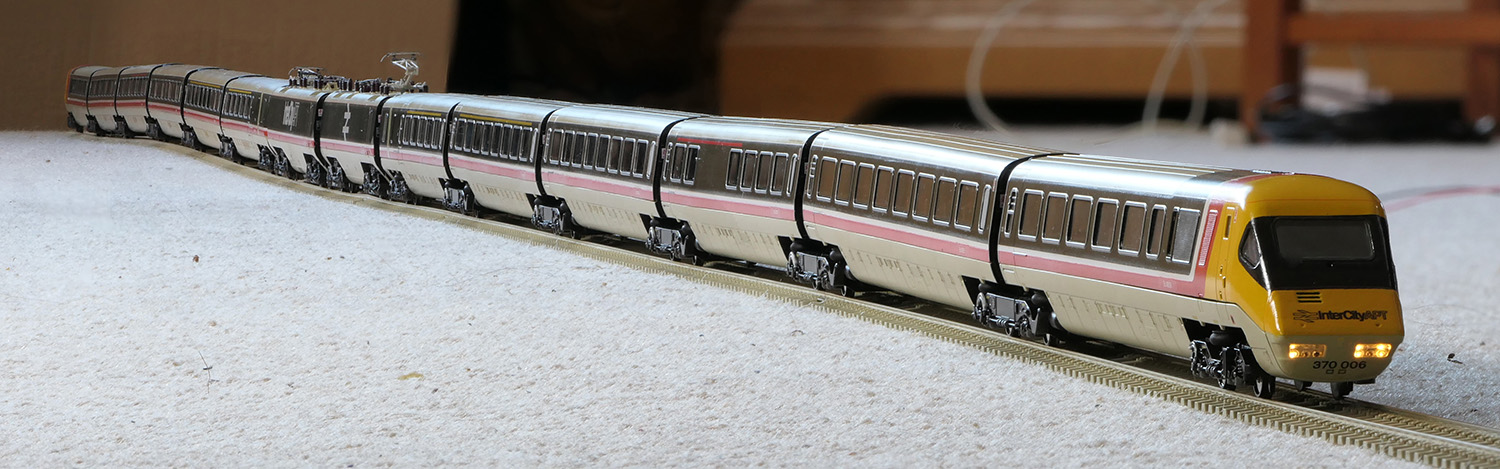
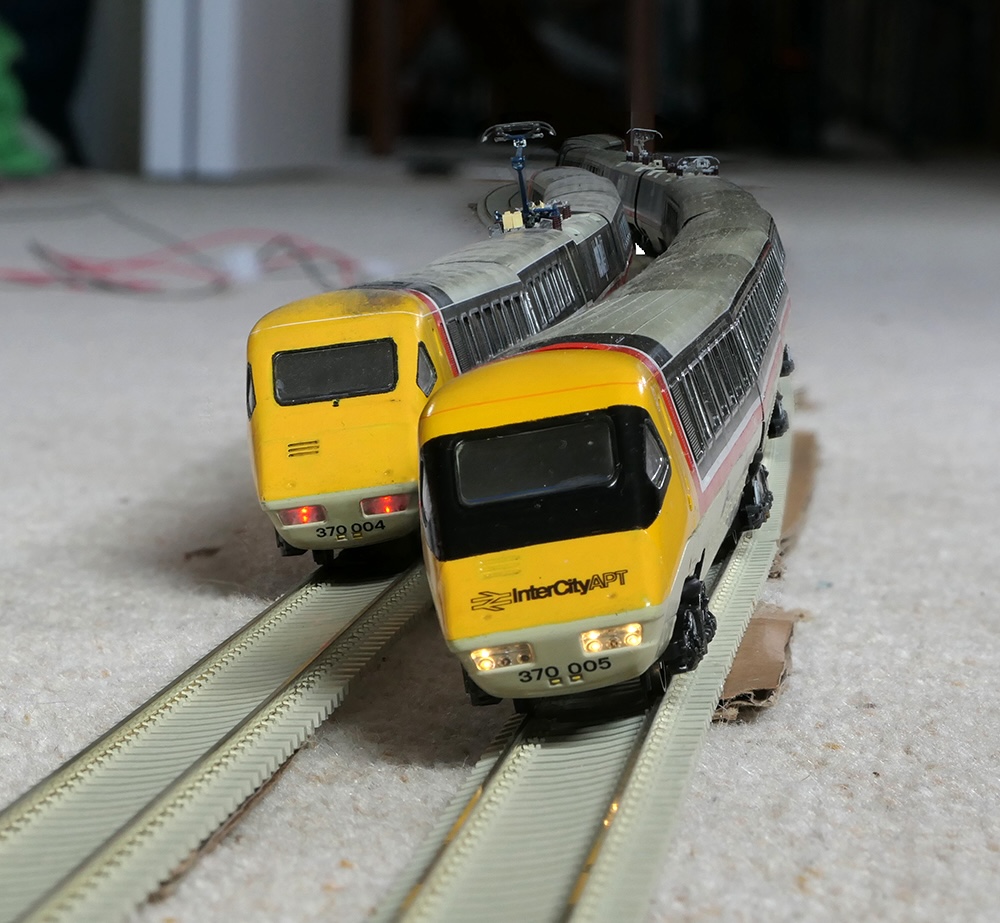
Hornby's tilt mechanism only works on 1st radius curves, so I had to cheat and cant the track at about 15 degrees.